


In her book A More Perfect Union: The Europe We Need, Marina Wheeler offers a principled viewpoint on one of the most polarizing debates in contemporary British and European politics: The European Union. Written almost six years post-Brexit, the book revisits nostalgic sentiments towards a past long gone, and the biting criticism and resentment of the EU at the time from different campaigns.
By Jenane Kharbachi
Picture: Via Pixabay, CC0
Wheeler, a barrister specializing in public and human rights law and the ex-wife of former British prime minister Boris Johnson, is arguably well equipped to write such a book. In it, she assents to and reflects upon the intense criticism and hostility directed at the EU during that period. Yet it is precisely this lingering indignation, and the remnants of self-perception as a world leading power that ultimately limits the book’s persuasiveness. This is especially evident at a moment when the consequences of Brexit such as diminished influence on the world stage, pressure from domestic and foreign far right groups, and the dangers of division in an already divided world are increasingly visible.
In her book, she argues that The EU and The European Court of Justice’s overreach in matters of immigration, legal sovereignty and regulations were the driving force behind Brexit as many felt victimized by EU laws that should have been decided at the level of the nation-state alone. She also argues that to reestablish a better union with the EU, radical change within it must occur, in order to redefine what the project currently is, how it functions and what it stands for, which by the end of it, will not resemble any single existing model.
Selective History and the Politics of Grievance
Wheeler introduces her ideas in a roughly chronological order across four chapters. She begins by pinpointing the current situation of the EU-UK relations, followed by her opinion on the issues that led to the separation, which can be summed up in three words: regulations, sovereignty and immigration. Finally, she outlines her proposed solutions and reforms that could eventually help reestablish a new form of union. From the outset, the issue of sovereignty takes center stage. Wheeler repeatedly argues that EU membership undermines UK democracy – she critiques policy and political decisions made in Brussels, Strasbourg and Luxembourg by unknown politicians and judges, who in her opinion are increasingly losing touch with citizens explaining that she »felt that the EU had come to mistake its own interests for those of its citizens«. However, she notes that she was enraged in regards to an EU ruling concerning what she put in quotation marks ‘digital rights’ designed to protect individuals’ privacy, and prohibit mass data retention by phone and internet companies, under the EU charter of Fundamental Rights. Her own example reveals a vital contradiction in her argument. While she criticizes Brussels politicians and judges for being disconnected from ordinary citizens, she simultaneously appears to support the UK government’s extensive surveillance of its own population. This undermines her claim that EU decision making is the one out of touch with the people, which raises the question whether her concern is truly accountability from overreach, or whether it is only selectively applied when the UK government is involved and not its people.
On the topic of immigration, she criticizes the establishment for what she called hysteria, accusing them of labeling brexiteers as racist, she expresses »They most infamously, produced a callous and misleading poster of Syrian refugees on the Slovenia-Croatia border. The other was the Remain campaign which clearly preferred accusing Leave supporters of racism to actually discussing the merits of the EU«. To her, Brexit is about sovereignty, and nothing else, even if it means allying with far-right groups to get it done. She also states that »the UK has done enough leaving.. we should be leading«, which at its core, is the crux of the matter. For her it is the UK’s desire to be the leading European power in the EU, but lacking the power and influence to do so. This in turn, has built more resentment over the years towards the union and its more dominant members, particularly France.
Regulations and Sovereignty as a Binary Condition
In the late 1970s, neoliberal policies rose to prominence mainly under two world leaders, US’s Ronald Reagan, and UK’s Margaret Thatcher. These policies pushed for free markets, monetarism, small government and minimal state power; factors many argue reduces democratic control and a nation’s sovereignty, and shifts power in the hands of markets, treaties and corporations.
The UK’s decision to join the EU until Brexit was a sovereign, democratic choice, reflecting a commitment to shared governance. Wheeler reduces this history to a vote driven by »resignation rather than enthusiasm« and a failed economy during the Cold War era: »By 1961, however, with confidence low and the economy flat, the UK changed its mind and decided to apply to join the EU«. This characterization, whether in reality true or just political theater, suggests that the UK always kept one foot out the door when it came to their commitment to the EU, and joining primarily to benefit from the system. Quoting British politician David Owen, Wheeler herself acknowledges that »we joined it as a common market. It became not a common market but a political union«. A statement that is either purposefully dishonest or surprisingly misinformed from someone who has spent her life in and around politics. The EU has always been a political project since its inception, designed to foster peace between member states after World War II through economic cooperation and political stability.
Another aspect to consider is the UK’s assimilated law. According to the latest UK government count, there are currently 6925 individual pieces of retained EU law, 4351 of which remain completely unchanged. One notable exception is the environmental sector, where the UK has largely lowered EU environmental standards. For instance, in the span of just two years, the Guardian, reported on multiple negative new environmental laws post Brexit, such as weaker pesticide regulations, permitting development over protected habitats, and reducing water quality testing from annually under EU law, to every three years. This resulted in only 14% of rivers being in good ecological health, and not-met standards for good chemical health, which begs the question, is UK’s claim to sovereignty as an independent state contingent on compromising the health and interests of its citizens and their ecosystem.
State Power, Immigration and the Rise of Populism
Immigration is one of the most important and polarizing issues of our time, sparking heated debates and intense emotions, and Wheeler herself discusses it multiple times in the book. She acknowledges its significance, but consistently falls short in recognizing its deeper implications. She accuses the establishment at the time of ›hysteria‹, when pointing out the role racism played in the debate, and even when addressing immigration and UKIP, she only labels them as callous for overtly racist rhetoric.
The leave campaign clearly aligned itself with people and rhetorics that were explicitly radicalised at the time and continues to be so today. It’s one thing to critique the remain crowd for their motivations for wanting to remain in the EU, but it’s quite another to ignore the prevalence of racist rhetoric, deny its existence and pretend it wasn’t a significant driver in the Brexit campaign. Speeches made by UKIP’s Nigel Farage at the time say exactly that for example during one of his speeches in 2016 he said: »remaining inside won’t just mean open borders with the likes of Poland and Romania. It will mean far more than that«, and in the same speech, he adds »this year will see Turkey […]. Gain full visa-free access to Europe, effectively moving the Syrian border to Calais«.
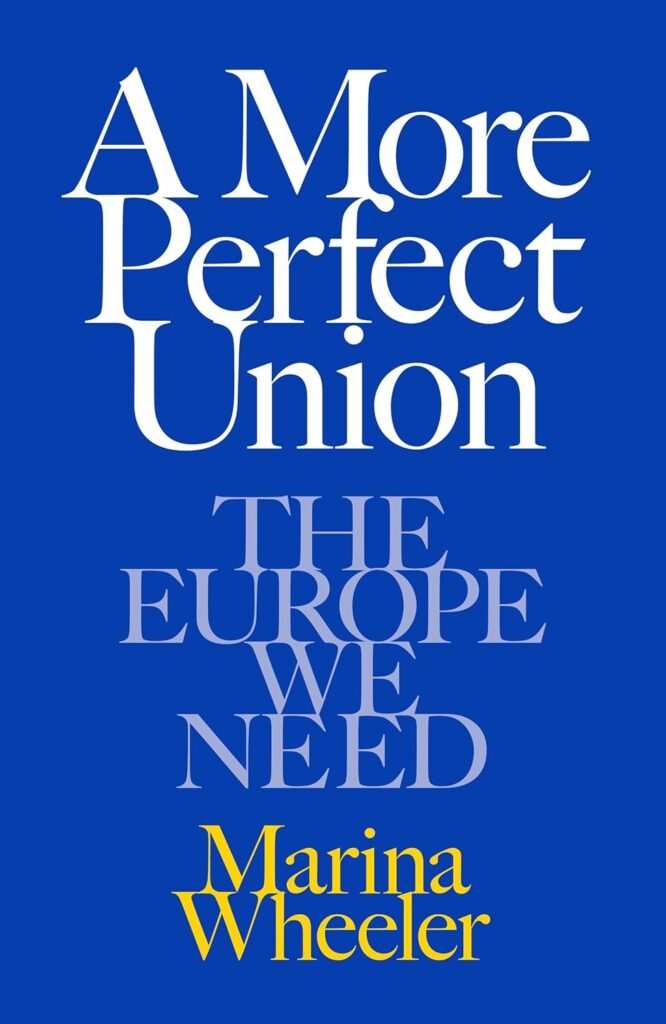
A More Perfect Union: The Europe We Need
Weidenfeld & Nicolson: 2025
160 Seiten, £14.99
Reshaping the New World Order
As the »doomsday clock« moves closer than ever to midnight, Marina Wheeler’s book A More Perfect Union: The Europe We Need, seems to promise a pragmatic and forward thinking vision for the UK and the EU, but unfortunately remains shackled to the very grievances that produced Brexit. Wheeler’s arguments repeatedly fall into the trap of selective history, inconsistent standards and a romanticized notion of sovereignty that fails to grasp the realities of global interdependence. Therefore, she ends up reducing structural political issues to matters of national pride and what she perceives as an “insult” because the UK does not play a leading role in the EU. At a time when authoritarianism is resurging, international cooperation is more necessary than ever, and so this nostalgic attachment to unilateral control and perceived power feels less like a solution, and more like a defeat. Brexit has not restored the UK’s sovereignty or influence, instead it has shown how limited it is in isolation. The EU is undoubtedly far from perfect and in desperate need for reform, but Wheeler’s vision only offers a blueprint that plays into the hands of political extremists and anti-liberal democracy sentiments, and fails to take accountability for the UK’s part in weakening the perceived unity among the EU member states, especially at such a critical time in history.
Ultimately, A More Perfect Union, reads less as a roadmap towards a new union, and more as an expression of unresolved resentment, showing that the politics of grievance may result in Brexit, but they cannot build a stable and prosperous future for the UK in isolation. One could argue that if Britain wants to regain influence in Europe, closer cooperation with other European countries would be more effective than appeals to imperial nostalgia.