
The Jaipur Literature Festival, hosted in India, offers a vibrant platform to examine social, historical, and contemporary global issues through literature and dialogue. Bringing together global voices, it is a must-visit cultural experience.
By Tripti Sharma
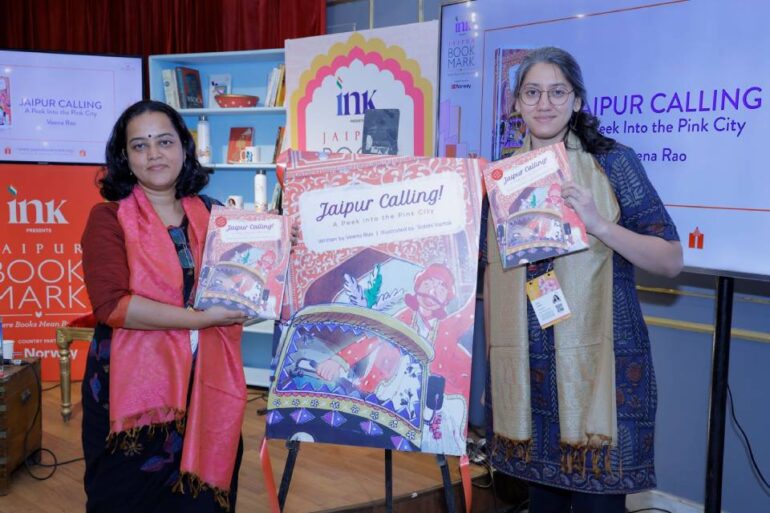
Picture: Book launch of »A Peek into the Pink City« (Anushka Sahai/Jaipur Literature Festival)
The Pink City of India, Jaipur, once again comes alive with well-read intellectuals, eminent writers, critics and literature enthusiasts at one of the leading literature exchanges. Jaipur Literature Festival (JLF), a local literary fiesta quickly grew into an international event, was founded by William Dalrymple in 2006. JLF has always been diverse and multidisciplinary at its core to promote dialogue among numerous cultures to touch various paradigms of literature and culture world that immensely contributed to its popularity.
The 19th edition of Jaipur Literature Festival (JLF) 2026 from January 15 to January 19 commences on a vibrant note offering audience a wide range of experiences such as musical night, open-stages for literature exchange, food courts, cultural exchange through puppet shows and commercial stalls – displaying local art, all under one roof. On the second day of the literature festival, January 16, the program enlivens by reflecting series of Rajasthan’s indigenous dances, culture, heritage and traditions.
Assortments of Literary Conversations
Throughout the second day of JLF, the critical discourses highlight a blend of formats ranging from author conversations to panel discussions, storytelling and reading of newly launched books of prominent writers from across the world such as Stephen Greenblatt and Andreas Unterweger. The national and international speakers dig into expansive topics and genres undertaking conversations on literature and imagination with Stephen Fry and Kiran Desai, and the extensive panel dialogue on the burgeoning kid lit industry.
Although global conversations on political discourses such as authoritarianism, tensions in Gaza and Ukraine and economic impacts of war took the center of the stage; discussions on AI, robotics and sustainability would have been a cherry on the cake. Considering the growing need to educate the enthusiastic visitors of JLF on the use of GenAI and adopt viable practices to conserve natural resources; the next edition of the Jaipur Literature Festival should look forward to contemplating the impact of AI on generating meaningful literature in the digitally driven world and certainly have conversations on the role of AI in rewiring childhood across the globe.
Savoring Greenblatt’s Renaissance
As JLF covers the nooks and corners of the literature world, American literary historian, Stephen Greenblatt discusses his fresh off the press book Dark Renaissance: The Dangerous Times and Fatal Genius of Shakespeare’s Greatest Rival. The Harvard professor and Pulitzer Prize winner, Greenblatt, with Lucy Hughes delights audiences by giving insights into his book in the late afternoon. The awe-inspiring audience floods the venue, immediately grabbing the seats with a better view of the stage and the house was full in no time.
Greenblatt’s conversation transpires to be an amalgam of history, with a pinch of comedy and a review on hidden power dynamics, fear and pleasure during Elizabethan era. His book lets the readers revisit the life, relationship dynamics and power struggles of Christopher Marlowe and his contemporaries, such as Shakespeare, opening new possibilities for reinterpreting the golden period of art. Greenblatt reiterates, »Marlowe, son of poor cobbler with three illiterate sisters, lived a life full of miracles« as he unlocks the educational system through scholarships unlike his family members. Kit Marlowe’s life journey as examined by Greenblatt was no less than a roller coaster ride. Marlowe had known people from various backgrounds such as from being with aristocrats during schooling to joining a covert intelligence network to root out catholic conspiracies against Queen Elizabeth I. Marlowe’s peculiarity of mingling with diverse people makes him outstand his contemporaries.
Greenblatt goes on describing how »Marlowe was prestigious whereas Shakespeare was only a learner, who never went to the university« Marlowe because of his extraordinary life had access to different personalities, which is also reflected in his ground-breaking works such as Dr. Faustus.Whereas Shakespeare was focused on projecting the Elizabethan audience either from lower or elite classes. After a prolonged examination of Marlowe’s life, the question that arises among the audiences were, »could Christopher Marlowe be the Father of English Drama if he would have not died at a young age of 29? « Marlowe had already created his amoral universe in such a short span of life. If he had lived a little longer, he would have been recognized as the most renowned dramatist based on the extraordinary themes he touches upon such as queer love in Hero and Leander.
As the speakers ran out of time, the highly anticipated question-and-answer session did not receive the attention it deserved. As a literature scholar, the book discussion session left me pondering whether Shakespeare’s style would have evolved in the same way without Marlowe. However, many literary critics and scholars like myself will now have the opportunity to delve deeper into history and examine how violence, power, executions, and suffering challenge the Eurocentric glorification of the Renaissance period.
A Sweet Closing Note
JLF turns out to be a thought-provoking cultural arena that goes beyond literature, bringing together conversations, performances, and ideas that reflect the social realities literature seeks to explore. This was especially evident on the second day which concluded with musical performances by Yugm, a band that uses melody to engage with contemporary Indian issues such as taboo around menstrual hygiene. Through cultural discourses, keynote sessions, author conversations, and such musical segments to the festival ultimately bridges the gap between people from different countries who are divided by boundaries and cultural diversity but are united by similar stories.