

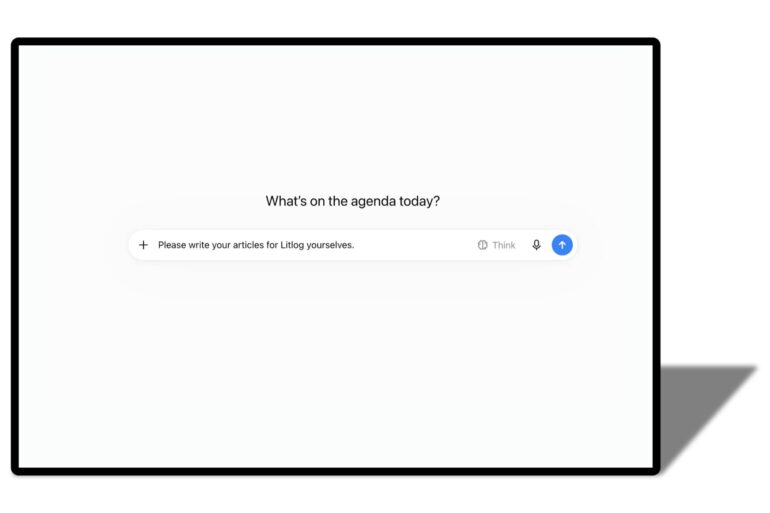
We see ourselves as a magazine where you can learn the craft of cultural journalism. The core of what we do – the writing and editing process – is difficult to reconcile with the use of AI tools. So how do we want to approach this current trend of AI usage? This is our attempt, a set of guidelines that may well be outdated again before long, who knows.
By the Litlog Editorial Team
Picture: Private
Litlog, too, has lately received a number of texts generated with the help of AI that were not labelled as such. It was immediately clear to us that this lack of transparency was incompatible with the standards we set for Litlog – but how should we approach generative AI more generally? The broader societal debate about the use of AI tools had now reached us as well. We have therefore had extensive discussions within our editorial team about the role that generative AI, particularly in the form of Large Language Models (LLMs), should play in our project.
Usage and Critique
Our shared position is this: The use of LLMs runs counter to Litlog’s core idea as a learning project. We trust that you, our fellow students and authors, write the texts yourself and write for us because you want to learn. Within clearly defined limits, we will allow the use of AI tools for tasks such as finding a topic, checking spelling, or helping with the wording of individual sentences, as long as you are transparent about it and use tools provided by the university. We will add an appropriate disclaimer to the texts written with the help of LLMs. If we have good reason to assume that the text, either in its entirety or in individual paragraphs, was written by an LLM, we will not publish it. Whatever writing problem you encounter, we’ll find a solution at Litlog – you just have to ask!
How did we come to this conclusion? We cannot categorically rule out the possibility that there are areas in which AI-assisted technology can bring about genuine improvements, but we remain highly critical of the development of AI tools. Our reasons are the following: LLMs in particular are notorious for making false claims and presenting them as facts. There are also serious concerns around data protection and privacy – but more on that below. The energy demands of AI applications are immense and they consume enormous amounts of water. They can cause the human brain to unlearn skills it once relied on. The AI bubble is no longer disputed even in Silicon Valley, and its collapse is likely to have devastating economic consequences worldwide. In the Global South, so-called content moderators are traumatised by their work, as they are required to spend hours every day viewing discriminatory and violent content in order to keep it out of (some) AI systems. Behind the tech companies developing the most successful AI tools stand authoritarian men such as Zuckerberg, Andreessen, and Musk, some of whom openly invoke fascist thinkers or endorse far-right views; AI benefits a resurgent fascism.
Litlog as a Project for Learning
At Litlog, you have the opportunity to try your hand at cultural journalism and gain first writing experiences. Throughout the process, you will be supported by an experienced editor who does more than simply correct your work. They are there to discuss the structure, style, and content of your text with you. Litlog is, first and foremost, a project for learning – for you as much as for us. One thing is clear: if you let LLMs take over all or large parts of the writing process, you cannot properly learn that process yourself. If you do not practise writing and all the individual steps that come with it yourself, you will also struggle to distinguish useful LLM output from poor-quality output. And that does not even begin to address the problem of distinguishing true claims from false ones.
Our goal is to turn unfinished drafts and half-formed ideas into something you can be proud of. The finished piece is something you can point to as an author and something potential employers can find when they search for your name online. We believe that what you publish under your name at Litlog matters. That is also why we work closely with you throughout the editing process and are always there to listen if you run into problems. Human exchange is at the heart of what we do. For that reason, we want the published texts to be written without the assistance of LLMs.
We strongly advise against using LLMs for tasks such as spell-checking or suggesting alternative phrasing, especially since practical alternatives for these proposes are already available. Every word-processing program has its own spell checker, and you can find inspiration for your articles anywhere – first and foremost by talking to your friends, fellow students, or us. If you instead turn to LLMs for tasks that can just as easily be handled in other ways, we believe there is a considerable risk that your content will be altered or that you may get into habit of offloading tasks you do not enjoy but that are nevertheless part of every writing process. In the worst case, you may no longer be able to stand behind the content of your own text nor will you be able to develop a style of your own. You would be depriving yourself of the opportunity to learn while at same time using a particularly resource-intense tool where a simpler alternative would have worked just as well.
Our Request to You
We expect you to be transparent about your use of AI tools. If we suspect that an article may have been written with the help of an LLM without being disclosed as such, we will ask you about it. If AI tools have been used for non-generative tasks such as finding a topic, spell-checking, or suggesting alternative phrasing, we can still publish the text. However, we will add a disclaimer to the article stating which tool was used and for what purpose. If we have reason to believe that the text was not written by the author themselves, to the point that statements about its subject matter can no longer be considered reliable, we will not publish the article, as we believe this would go against the purpose of Litlog. Put simply: We hope that you will choose not to use AI tools, although we tolerate their use within clearly defined limits.
If Ai tools are used, they must be employed thoughtfully and critically. Those who resort to them may pay for them through a monthly subscription, but above all, they pay with their own data; everything entered into an AI tool is added to the company’s databases and may be used for other purposes. This becomes particularly problematic in journalistic writing when an LLM is given texts that are already being prepared for publication, or when a draft, for example the raw transcript of an interview, contains sensitive information about you or another person.
For these reasons, we do not want you to use AI tools that further process the data you enter. If you turn to AI tools at all, you should use those provided by the GWDG, at least where they operate within the university’s own infrastructure. ChatGPT, for example, is only available there as an external tool and therefore does not meet our requirements.
A Solution for Every Problem
More generally, it is questionable – and currently the subject of dozens of court cases – whether tech companies have obtained the training data for their AI projects under ethically acceptable conditions, particularly when it comes to issues such as copyright. LLMs are also of limited help when it comes to journalistic writing on current topics, such as newly published books or sociopolitical developments, simply because there may not yet be sufficient data available on the subject in question.
Thus, even setting aside our aims as a learning project, we consider the usefulness of LLMs for our work in cultural journalism to be limited. We believe that the problems we regularly encounter can be solved in other ways – running out of time or haven’t finished the book yet? Just as for more time, there are no fixed deadlines! Struggling to find the right words or to make your point clear? Ask us, that’s what we’re here for! You think your text isn’t good enough? Tell us what is bothering you or what you are unsure about, and we’ll work on improving it together!
The Passion for Writing
We are a small editorial team of around ten people, most of whom work with you on your texts on a voluntary basis. We invest time and energy in the editing process because we believe that working on these texts is worthwhile and can lead to genuinely good results. We want to learn something from and about your texts, develop critical ideas through discussions with you, and encourage you to express your opinions and support them with strong arguments. We take pleasure in working with texts and thinking critically, and we want to pass both on to the authors who write for us. No LLM can replace this.
LLMs are designed around efficiency and economic interest. We, however, are free to decide whether and how we use our own minds. As aspiring professionals in the humanities who work at universities, publishing houses, or newspapers, we can distinguish ourselves through the very skills that cannot simply be replaced. We want to stand by our own expertise by doing our own work. If that appeals to you and you would like to write a review, an event report, an interview, or something similar for Litlog, we would be delighted. And if it doesn’t, that is completely fine too – after all, no one has to.