


The movie Kinds of Kindness challenges viewers to confront the dilemmas posed by characters’ willingness to submit to abuse and control across three segmented stories. It interrogates the price of seeking love or comfort by surrendering one’s psychological and physical independence.
By Shakiba Ghiasi
Picture: via Pixabay, CC0
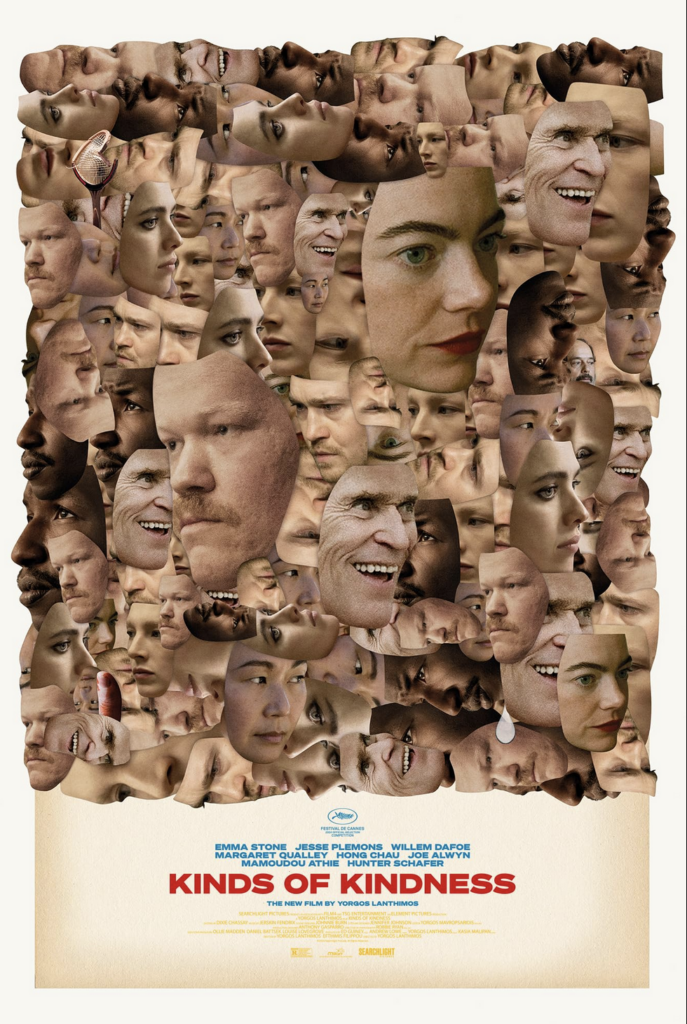
The movie Kinds of Kindness (2024) is an anthology consisting of three stories with interrelated meanings. It features the same actors performing as different characters in each story and is directed by Yorgos Lanthimos, following the release of his famous movie Poor Things (2023).
Kinds of Kindness is not entertaining in a conventional, ›popcorn movie‹ sense; rather, it is mysterious and eccentric, inviting viewers to reflect deeply and continue thinking about its meaning long after watching. Since the director is reluctant to discuss the concepts of his films analytically (choosing not to define their themes or meanings in interviews), it becomes difficult for viewers to engage more deeply with the film beyond their own reading and interpretations of it. This approach aligns with the director’s intention and underscores his genius. Lanthimos has other movies as well, such as Bugonia, Dogtooth, The Lobster, all of which are full of semiotic elements that invite interpretation beyond the narrative.
The first aspect of Kinds of Kindness that attracts attention is the music played in the beginning: Sweet Dreams are made of this. It is about the dreams that everybody pursues, follows, and seeks. It conveys a cyclical view of human desire; some people seek to use, others to be used; some wish to dominate, others to surrender. The whole storyline of this movie revolves around this idea, prompting you to pause and reconsider your relationships with loved ones, friends, and everyone you are in touch with. To delve deeper, this review analyses the concepts of the story through James Phelan’s rhetorical narrative theory, explicitly focusing on narrative judgements and their implications in this storyline.
James Phelan’s Narrative Judgements
Narrative judgments are a crucial link between the audience and the story. Viewers and audiences make various types of judgments as they engage with a storyline. These include interpretive judgments about the meaning of events, ethical judgments concerning the moral value of characters and their actions, and aesthetic judgments regarding the artistic quality of the narrative and the form of its parts. Phelan adds two corollaries: »Corollary 1: a single action may evoke multiple kinds of judgments. Corollary 2: because characters’ actions include their judgments, readers often judge characters’ judgments«. Furthermore, in Quo Tao’s view, »Phelan introduces the typology of narrative judgments; the interrelations of narrative judgments and the possibility of double judgments. Moreover, we may classify the three types of judgments into two levels: the first level is the character’s judgments and the second level is the audience’s judgments«.
R.M.F.’s Death
In line with Phelan’s theory, Lanthimos’ movie is analyzed as embodying this triadic model. The first story is called R.M.F.’s Death. This story is about a man whose life is controlled by his boss, even his sexual relationship with his wife. His boss orders him to kill someone, which leads to his disobedience and exclusion. He stands against being abused by his boss; however, his world is defined by him and his orders, so he tries to return at any cost, becoming a sheep who follows the shepherd. Lanthimos presents a similar concept in Dogtooth, where a father redefines everything in life as he seeks to control and manage his family. Both films explore the concept of adapting to circumstances and the willingness to attach to them to avoid stressful situations. Viewing this movie through Phelan’s ethical judgment lens prompts you to assess whether the characters’ actions are morally right or wrong. Also, the interpretive judgment of this segment is that it is a parable of absolute, dehumanizing power dynamics. This power is absolute because it extends beyond R.M.F.‘s work and dictates his personal life, sexuality, and very sense of reality, creating a totalizing system of control from which there is no internal or external escape. Moreover, in terms of aesthetic judgment, the audience appreciates its strange yet realistic details that sometimes remind them of situations they encounter.
R.M.F. Flies
R.M.F. Flies is the name of the second story in this movie, which is about a woman who gets lost on an island and returns to her husband when she is rescued. As the story unfolds, it becomes evident that the man is a maniacal character; nevertheless, the woman continues to wait for reunion with him and wants to stay in this life at any cost. For instance, before being rescued, the man watches a group sex recorded movie with another couple to recall his wife’s memories. In another shocking scene of this movie, he orders her to cut her finger for him and feed the severed digit to him, to which she complies. She does her best to stay there, even at the cost of her death.
Kinds of Kindness (2024)
Director: Yorgos Lanthimos
Moreover, the female character, played by Emma Stone, shares her dream with her father about dogs that kindly rule and feed people. In fact, in real life, her loyalty to her husband closely resembles that of a dog. This analogy is part of my ethical judgment through Phelan’s lens, suggesting her submission is a learned, self-sacrificing devotion akin to that of a domesticated animal, reminding us of our brutal character and the need to maintain balance in our actions. This ethical judgment reminds us of the brutal human impulse to seek absolute dominance or absolute submission, compelling the audience to introspect on the necessary balance and autonomy required to resist these dehumanizing power spirals.
Another instance of this dynamic in the story is that Emma Stone initially hates chocolate in the beginning, but in her dream, she must eat it because it is the only food available. She develops a perverse satisfaction with this singular, inescapable option in her dream, and this psychological conditioning leads her to consume chocolate every day in real life. This manufactured contentment with chocolate prevents her from daring to pursue her real interests. This indirectly suggests that she chooses to tolerate her husband and stick to low expectations for her life rather than risk challenging the established order. In other words, the woman’s decision to settle for the figurative ›chocolate‹ (her abusive reality) and remain with her husband is a character’s judgment, a choice for perceived safety and stability over original desire and autonomy. Therefore, the audience is compelled to judge this judgment.
Regarding the ethical judgment lens, we often tend to stay in our comfort zone rather than following our genuine interests, exploring new things, and experiencing them. Thus, we ethically condemn Liz’s self-limitation; i.e. her choice to remain in a comfortable yet abusive status quo rather than pursuing autonomy. And although she dies in the story, the character who acts as the surviving character in the rest of the movie is her husband’s illusion, which reminds us of the trope »dead wife is a good wife« – the ideal compliant partner existing only as an idealized memory.
R.M.F. Eats Sandwich
The last story in this movie is named R.M.F. Eats Sandwich, which is about becoming an enslaved person at your own will, passing humanity’s boundaries, and having free sexual relationships. However, Phelan’s ethical judgment prompts us to consider the extent to which we should be free. It urges us to reconsider whether a life without boundaries can still be described as humanitarian or whether the abandonment of bodily and moral limits signals a descent into brutality. Do we prefer a humanitarian life or a brutal one? In the third story, a cult is looking for a woman who can revive the dead. At last, they can find someone, but the question is why she dies herself. This suggests that even the supposed saviour succumbs to the same mortal fate as any other person. This outcome leads to the conclusion that the human position transcends that of a sheep, and its independence is the key. In other words, throughout the story, the cult represents complete submission to a higher order, and members follow instructions blindly. The woman possesses a higher power or freedom from this control, and her eventual death suggests true independence is to step outside the cult’s structure, even if that means destruction.
The Price of Kindness
To recap, R.M.F., an unknown feature, serves as the connecting chain of these three stories, as it appears in the titles of each story. For instance, it appears on a character’s shirt, but the film never explains what it stands for or signifies, leaving its meaning ambiguous. The movie is about three categories: job relations, beliefs, and conjugal duties and rights. In this movie, everyone accepts being used or abused by others to be loved. As the movie’s name suggests, kinds of kindness is vital, but to what extent are we allowed to treat others in a friendly manner? Controlling others, being controlled, abusing them, being abused, and accepting these roles are the main themes of this movie; in other words, this movie presents a bilateral interplay of control. This dual dynamic captures the essence of the Sweet Dreams (Are Made of This) lyric: »Sweet dreams are made of this / Who am I to disagree? / I travel the world and the seven seas / Everybody’s looking for something.« In line with Phelan’s ethical judgment lens, this movie makes the audience reconsider the values governing their own lives; for instance, in relationships with parents, partners, society, and even social media and their effects on decisions. It also prompts us to reflect on our actions, which result from critical thinking and self-analysis, or simply adopted from what we see or hear confirmed by others.