
Analysing Zadie Smith’s White Teeth, this autobiographical essay explores ›neutral space‹. Contrasting the characters’ struggles with colonial heritage against the author’s own upbringing, it argues that true neutrality is an active state of questioning – a ›Literat‹ identity forged in-between cultures.
By Abdullah Talha Furkan Öztürk (ATFO)
I recently read White Teeth by Zadie Smith. It made me travel to my past and my future, meeting their ends in this present moment. The important characters to know for this Lightbulb Moments Series article are Archie, Joyce, Clara, and Irie. The novel’s protagonist is Archie, an indecisive postcolonial Englishman who divorces his Italian wife (Ophelia Diagilo) to marry a Jamaican woman named Clara. Clara is a first-generation Jamaican immigrant in England. Their daughter is Irie, a second-generation immigrant. Lastly, Joyce represents the white, middle-class wife in an intellectually inclined British family.
In this novel, fate and free will collide. The characters seek a ›neutral zone‹ to express their lives freely within England, yet the community grounds them with burdens of identity. Archie wants to escape his colonial heritage, while Clara seeks acceptance as a Jamaican woman in England. Irie is discriminated against for her looks in the school because of her curly hair whereas Joyce is interested in a dark-skinned man, but struggles to express her emotions to him, instead, she is married to a white British man. They all attempt to create a neutral space where their lifestyles match the communal reality. But where is this space?
The Neutral Space in the Novel
Neutral space first appears when Archie flips a coin. Contemplating free will but bound by his colonial background, he realises that even opposing the system is a reaction to it. So, he leaves the decision to a coin flip. The coin somersaults into a pinball machine, and the game plays itself out in chaos. By giving up on binary choice, Archie frees himself from his old identity. But is he truly free if the coin is the product of the same system?
The true lightbulb moment, however, comes from the struggle to find one’s identity in a physical space. The narrator explicitly states that »the chances of finding neutral ground these days are slim« while also describing a university as a place where it might be possible. A kind teacher hands Clara the key to a university room built on »empty waste land – no Indian burial grounds, no Roman viaducts, no interred alien spacecraft, no foundations of a long-gone church. Just earth. As neutral a place as anywhere.« In this room, devoid of portraits, symbols, or flags, Clara gives the key to Joyce, who gives it to Irie, representing a neutral genealogy where no one owns the space, but everyone shares it. But can an institution like a university ever be truly neutral? Is it a fixed centre, or merely a transitional space?
In the end the university is still a construct of society, populated by people who carry their histories within them and the same goes for the coin and the pinball machine as productions of humankind. From another perspective, the university can be seen as a new kind of centre, a place where history is generated not from the past, but from the present moment of interaction. Perhaps neutral space is not a physical location, but the dynamic tension between the two – like the coin stood up in the machine, refusing to be heads or tails. It is in this tension that one begins to forge one’s own path.
Forging the Neutral Ground
Like the characters, I struggled to find a neutral space. With over sixty cousins and a devout Muslim upbringing, my life had a pre-written script. I was expected to pray five times a day, marry a virgin Muslim woman, learn Arabic, and fast for a month each year. I was expected to earn my daily bread, pay alms tax, visit the Kaaba, and adhere to strict prohibitions: never drink alcohol, never smoke, never swear, and interact with women only if they were close relatives.
However, I sought a different reality. I believed in the right to silence, the freedom to choose one’s attire, and the necessity of free speech. I chose to learn international languages to be understood rather than parroting words without comprehension. My plan was for a basic life: neither god nor servant, just human. Even my names were decided before my birth, each carrying an expectation. I was to be Abdullah (servant of Allah), but I chose to find wisdom in the unknown. I was to be Talha (a fruitful tree from heaven), but I became a tree of knowledge for this world. I was to be Furkan (absolute authority), but I became an author, transforming authority into self-expression. I was to be Öztürk (pure Turk), but I chose a global identity. I was given a genealogy tracing back to Muhammad and Adam, a rich heritage I was meant to spread. But I felt I was drowning in an ocean of culture, so I chose to swim toward my own dreams.
Lightbulb Moments: Insights from the Classroom
What topics captivated you during your studies and never let you go? Was there a seminar you once took or an exam you completed that led to an important new realization? Our series »Lightbulb Moments: Insights from the Classroom« is dedicated to making exactly these moments visible. Here, authors reflect on their personal »Lightbulb Moments« — those pivotal moments during courses or lectures that left a lasting impact.
The texts are published at irregular intervals and can be found here.
So, I Became a Literat
This is where I diverge from Smith’s characters. While Archie surrenders his fate to chaos, and Irie searches for a reflection that doesn’t exist, I chose to actively write my own story. In the novel, Irie Jones stands before a mirror, desperately searching for a reflection that matches how she feels. She looks for a ›neutral‹ version of herself but sees only the ›strangeness‹ of her body and her curly hair – features that English society refuses to validate. She waits for the mirror to give her an answer, to show her a genealogy she can belong to. I learned from her struggle that if the mirror of society does not reflect you, you cannot simply wait; you must build your own frame.
I became a Literat. Literature is my neutral ground. It is a space I created between the writings of others. Unlike Archie’s passive coin flip, this is an active synthesis. It is here, in the space between myths and facts, gods and servants, that I learn from humanity without being forced to become any of what I read. To be a Literat, I must exist in between these ideas, absorbing them like a voyager. My central identity is not a fixed point, but a dynamic act of balancing on the tightrope between reading and writing.
This act of synthesis made me question existence. Was life a random alignment of genes, or a story chosen by a spirit? The human path seems to be a walk within this paradox. If the world is only real, we are prisoners of fact; if it is only a dream, we are lost in fantasy. The truth is that we are co-authoring the dream. One side of the binary needs the other to have meaning. Without a person asking questions, answers are just noise. I realised that embracing this state of constant inquiry was the only authentic path forward.
The Answer was to Question
Ultimately, the answer to the tension between chance and choice was the act of questioning itself. Zadie Smith illustrates that total neutrality is an illusion; the coin eventually falls. However, living within the inquiry is true freedom. From this perspective, I see the convergence of choices: Smith chose to write, my teacher chose to share it, I chose to write, and you chose to read. We are a constellation of choices meeting in the in-between space of this text. This work of art is not just my story or Smith’s story; it has become our story.
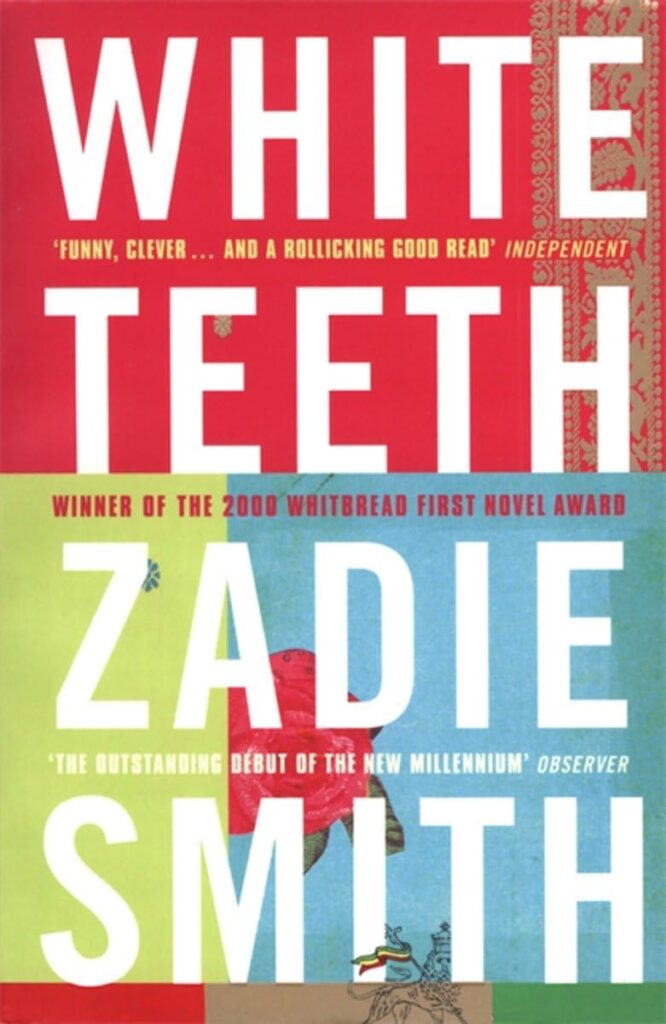
White Teeth
Penguin 2000
This shared experience contains everything. Literature, books, art, paintings, writer, readers, love, birds and water. From heaven to hell, we are in the world. We are always at the centre and in-between each other’s centres, too. This is our neutral ground. As I learn not to drown in the endless ocean of questions, my readers must land from their flight of reading soon. Like swans landing on a great lake, stay here on this water of knowledge to rest until it is over soon, for this act of staying is the true centre – the perfect balance in between the giving and receiving of ideas, or of coming and going. My pseudonym, ATFO, from Alpha to Theta to Fi to Omega, is found here, the name I have given to myself. Your imagination is the final element that gives these pages shape. In reading, you perform the same act I do in writing. Like Archie’s coin, flipped against all odds, these pages are flipped. We let go of a simple answer and, in doing so, become free. Until all my readers have arrived here to rest, I must go to live my present for my readers are my presents.