

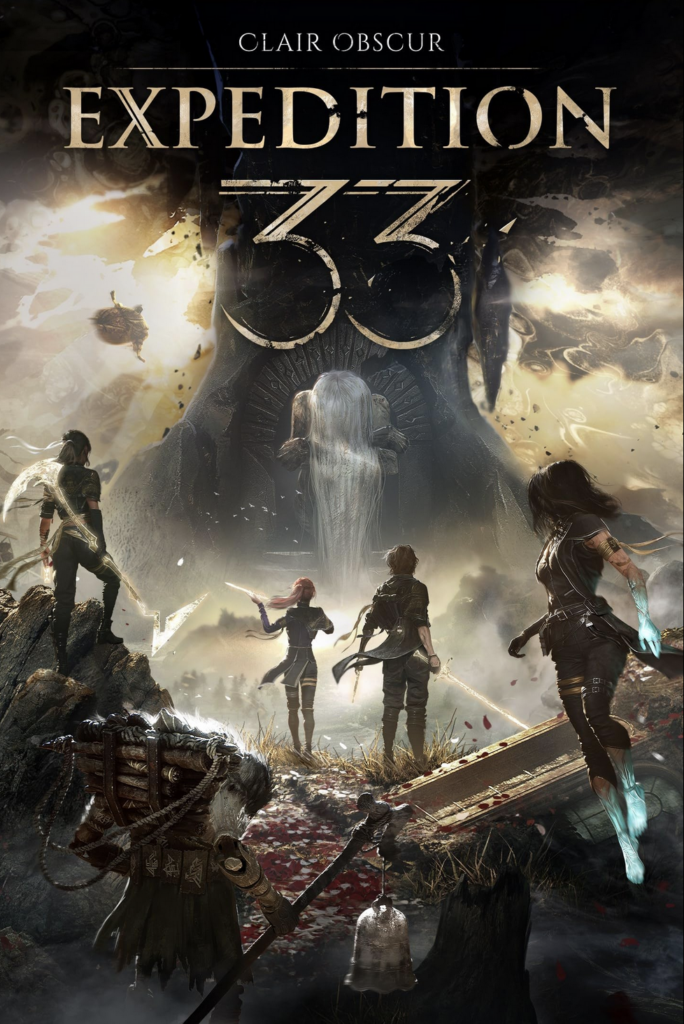
A group of people with little experience and no reputation decides to produce a niche video game—fast forward to one of the greatest successes the industry has ever seen. This is the story of Clair Obscur: Expedition 33.
By Jonas Darboven
Picture: Jonas Darboven
What to do if you want to experience a piece of art that nobody has created yet? You do it yourself! That is how Guillaume Broche (CEO & Creative Director) and Tom Guillermin (Technical Director) think when they meet in Malmö while working for Ubisoft. Together, they develop a prototype titled We Lost. It combines everything they love about JRPGs (Japanese role-playing games), amplified by a touch of French wit. However, if they want to be truly free with their passion project, they cannot be held back by Ubisoft’s demands.
Instead, in 2020, they found their own company: Sandfall Interactive. When Broche tells a friend from university about his idea, François Meurisse quits his job at Marcel (the French Uber) and takes the lift as Production Director. Next is Nicholas Maxson-Francombe, who designs the world and characters as Art Director, though he, too, has never worked in game development. A quick post on Reddit attracts in some voice actors, and a first demo is produced to interest investors.
»This is the definition of a fool’s quest.«
Fast forward to the 24th of April 2025. Clair Obscur: Expedition 33 launches and sells 3.3 million copies in 33 days. On Metacritic, one of the most influential websites that aggregates reviews and ratings for video games, films, and TV shows, the game has a user score of 9.6 at the time of this article, displacing Metal Gear Solid 3: Snake Eater, which has held first place for over twenty years. But while AAA games are produced by hundreds or even thousands of people, Expedition 33 is made by a core team of just thirty-two—including one dog, Monoco, who serves as Happiness Manager. (Every company needs a Happiness Manager!)
According to Guillermin, Sandfallowes its success to the Unreal Engine 5—a gaming engine that riddles many modern games with issues but is a blessing for small indie teams. Using this, they can conjure a world that feels like stepping into a painting. Or, as Guillermin puts it: »I can do everything. I am a god in this world!« Using the corresponding iPhone app, they can even implement motion capture for cutscenes, giving every character detailed facial expressions. However, that alone goes nowhere until Jennifer Svedberg-Yen claims the pen. Formerly working in finances, not exactly a creative field, she seeks new challenges and gets recruited via the post on Reddit—as a voice actress. Her discussions about the dialogue with Broche make him realize her talents and promote her to lead writer once the prototype We Lost becomes Expedition 33.
»Tomorrow comes.«
The prologue opens on a deformed Eiffel Tower, introducing Gustave, named after the civil engineer Gustave Eiffel. He is throwing rocks at a faraway monolith, imprinted with an ominous »34«, trying to hit the »Paintress«, a godlike entity cowering at its foot. Meanwhile, the streets are filled with festivities. Even though the initial idea was to focus on the British Victorian Era, the story was brought right next to home, into the French Belle Époque (›beautiful era‹). The city of »Lumière« is shown on a bright summer day. Sculptors, painters, and dancers revel in the annual celebration of the »Gommage« (›exfoliation, erasing‹), while the wind blows red and white leaves through the streets.
But at the same time, Lumière is influenced by the Décadence (›decay‹). The city is filled with construction sites, scaffolding, and tendrils growing on the architecture. Kids are crying, some people drown their sorrows in alcohol. Here, Gustave meets Sophie, his former love, wearing a red and white flower necklace. Together they make their way to the harbor, where everyone is watching the monolith across the sea. The Paintress rises from her slumber and repaints the counter to »33«. Anyone above that age, including Sophie, vanishes into red blossoms—a deadly hourglass. The next morning, Gustave and the expedition 33 embark with one goal in mind:
»Destroy the Paintress so she can never paint death again.«
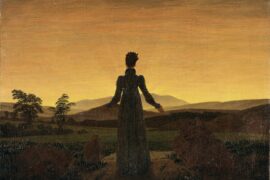
What follows is a story that sparks questions for every answer it provides. It’s like first seeing The Creation of Adam by Michelangelo before realizing that the rest of the Sistine Chapel ceiling tells an even bigger story. Focusing on artistic renditions of creation mythoi is a staple of the JRPG-genre, while French influences tie it all up in a relatable tale of family and sorrow. In paintings, one might be omnipotent yet ever so human in life. A first hint to this style of writing might be found in the name itself.
Clair Obscur written as ›clair-obscur‹ (eng. ›light-dark‹) is the French expression of the Italian ›chiaroscuro‹—a method in painting and woodcutting that focuses on the contrasts of bright and dark colors. In a similar vein, the magical life force of this world is called ›chroma‹, referencing saturation in color theory. Furthermore, the different items needed to reallocate skills or heal the party are classified as ›tints‹. Everything revolves around art as salvation and damnation.
But not only is the story beautiful to look at—it is also a treat for the ears. Gustave is voiced by Charlie Cox, best known for his Daredevil from the Marvel Cinematic Universe. Joining him are former Baldur’s Gate 3 voice actresses Devora Wilde and Tracy Wiles in supporting roles, as well as Shala Nyx as Sciel and Jennifer English, who voiced Shadowheart in BG3, as Maelle. As a veteran from Final Fantasy XVI Ben Starr lends his voice to Verso, next to Kirsty Rider as Lune and Rich Keeble as Monoco (yes, the Happiness Manager dog made it into the story!). Together, they face the Paintress—and another mysterious white-haired man voiced by Andy Serkis, most famous for his rendition of Sméagol/Gollum in Peter Jackson’s The Lord of the Rings trilogy.
»When one falls. We. Continue.«
While the world, story, and characters already give enough reason to get engrossed in this world, Lorien Testard adds his music. At 16, he teaches himself how to play guitar, which leads him to study music theory to become a guitar teacher. On the side, he composes fan music for his favorite games, like Donkey Kong—essentially fanfiction writing of the music industry. When he uploads his music on a now-forgotten niche music forum similar to SoundCloud, he catches Broche’s interest.
After drawing inspiration from the concept art and story snippets, he delivers 154 tracks of pure excellence, marking his debut as a composer with a soundtrack that rules the charts for weeks. Every scene is elevated—be it a melancholic view over the horizon, a pilgrimage through the bottom of the sea, or a boss fight against a stony rubber ball. For French speakers (or those willing to use digital translation), the vocals give even greater insight into the characters’ backstories and states of mind. At times, it’s heartbreaking to continue the game because the track hasn’t finished yet. That means something when the complete soundtrack exceeds eight hours. Even those who don’t play video games owe it to themselves to give this soundtrack a listen.
»For those who come after.«
Sandfall Interactive
Clair Obscur: Expedition 33
Kepler: Montpellier 2025
~ 45 hours, 49,99 €
Sandfall Interactive is a French Game Developer based in Montpellier founded by Guillaume Broche in 2020. Their first production of Clair Obscur: Expedition 33 was an immediate hit, selling 3.3 million copies in 33 days.
No wonder then, that at the Game Awards 2025 they won not only the Game of the Year category, but also the awards for the Best Game Direction, Best Art Direction, Best Narrative, Best Score and Music, Best Independent Game, Best Role Playing Game and Best Performance by Jennifer English. As Broche remarked when he received the award: »I want to extend a thanks to the unsung heroes of this industry: the people who make tutorials on YouTube on how to make a game. Because we had no idea how to make a game before. So, thank you!«
Clair Obscur: Expedition 33, on both a textual and meta level, stands as a testament to the possibility of dreams coming true—against all obstacles. Not only does it respect the players’ time, but it also rewards them with a ne plus ultra of artistic expression. It tells a story that resonates with feelings of self-doubt, turns despair into incentive, and encourages the pursuit of happiness even when on the ground. If anyone asks for a story to lose and find oneself in—this is it!