

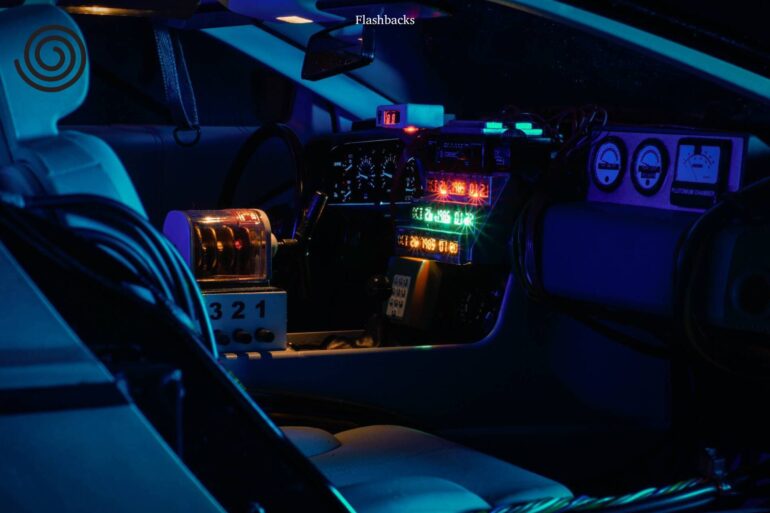
Back to the Future, a beloved 1980s science fiction adventure, uses time travel as a vehicle for exploring family, identity and the choices that shape our lives. Fundamentally timeless, this coming-of-age story continues to resonate across generations.
By Jenane Kharbachi
I discovered Back to the Future the way all the best things are found: entirely by accident. Late at night, during my early teenage years, when the rest of the house was asleep and the world was quiet, bored out of my mind and flipping through TV channels, a strange sound of ticking clocks and a colorful skateboard moving across a messy apartment caught my attention. It was the opening scene and within minutes, I was utterly awestruck. The vibrant 1980s aesthetic, the Americana charm of a fictional town called Hill Valley, and the metallic gleam of a DeLorean time machine completely captivated me. It felt like an escape to exactly where I wanted to be.
When the credits rolled, the channel announced it would be airing the sequel right after. Hours passed by and I finished part two, only for it to transition straight into the third, and I simply couldn’t move from my spot. By the time the trilogy had finished, it was 4 am, and it was the most immersive and captivating story I had watched in a long time. I went to sleep that morning dreaming of time travel, driving a DeLorean, and skateboarding through retro streets with neon lights, charting my course through time and space, while listening to rock music on cassette tapes.
A Journey Through Time
The films revolve around Marty McFly, a teenager who travels through time in a DeLorean, an iconic 1980s sports car, and Dr. Emmett Brown, known as »Doc«, an eccentric scientist who invents a time machine. The duo travels through different eras, including the year 1955, where Marty, while fleeing from Libyan terrorists, activates the DeLorean by mistake, and accidentally disrupts the timeline in which his father and mother met, resulting in him slowly fading from existence. This fading happens while he’s stuck in the year 1955, where his own hands turn transparent and his older siblings completely vanish from a present-day family photograph. The situation is resolved only when Marty manages to orchestrate a dance-floor kiss between his teenage parents, which in turn restores their original timeline and preserves his and his siblings’ existence.
In the second film, Doc and Marty travel to the year 2015 to save Marty’s future son from going to jail, only to end up with a dystopian timeline which they desperately need to fix. The DeLorean, in the third and final installment, is struck by lightning, sending Doc to the year 1885. Marty again travels to rescue Dr. Brown from being killed in the Old West, altering his history and bringing him back to the present. Doc ultimately decides to destroy the time machine and prevent further meddling in human history, as that has proven to be dangerous and highly unpredictable.
The Humanization of Parenthood
At the time, I had no idea about the trilogy’s important place in film history, or that it was a sacred cornerstone of pop culture. My first impressions were entirely my own, uninfluenced by outside critical reviews. I was in complete isolation from the cultural zeitgeist, and yet I ended up just as obsessed as the rest of the world. The aesthetics immediately draw you in, but the storyline hooks you on a deeply emotional level. Even if you never lived through the 1980s (or, for that matter, the 1950s), you cannot help but feel a sense of nostalgia toward a town you’ve never visited, and empathy for its inhabitants. The trilogy is the ultimate embodiment of teenage yearning, because it offers an adventure like no other, a little brush with danger, and the ultimate playground of science fiction in the form of time travel.
But beneath the futurism, the story, especially in the first film, offers a profound emotional truth: the humanization of our parents. The film forces every teenager to reconcile with the fact that their parents, too, were once young, insecure, and full of unfulfilled dreams. They had flaws that we, looking back, wish we could fix for them. Back to the Future grants that exact wish-fulfillment. By the end of the first film, the bully gets what’s coming to him, the good guys win, and structural harmony is restored. It creates a comforting fantasy where good triumphs over evil, and a single courageous act can rewrite a family’s destiny.
Returning to Hill Valley
Recently, I decided to rewatch the trilogy, perhaps out of a sense of nostalgia for a feeling I was chasing as a teenager. A feeling of belonging and understanding that I lacked then, and found now, in one way or another. There was a moment when rewatching these movies that I felt home again, in my living room alone at 4 am, and for one brief moment, a bridge formed across my own personal timeline, and I realized how proud that young girl would be of how far she and I have come together.
It felt just like the final scene of the first movie, where Marty McFly stands in his own living room, looking at his family with a quiet sense of awe, happiness, relief, and pride in how far they had all come. All because of one simple act of bravery from his father George, who managed to overcome his fear, and knock out his high school bully Biff Tannen to protect his crush at the time, Lorraine.
Flashbacks
In the series, we return to the books, films, series, music albums and games of our childhood and youth. What was our view of these things back then? And how has this view changed after years of academic studies? Reflecting personally as well as scientifically on such questions, we perceive not only the objects of our enquiry in a new way, but we also recognize the long road we traveled since our first encouter with them.
The texts are published at irregular intervals and can be found here.
A Bridge Across Time
Looking back today, that night felt a lot like peering through a real-world time capsule. Cinematically, the trilogy has aged remarkably well, its coming-of-age storyline and emotional impact feel refreshing in an era dominated by reboots and endless franchises with no character development and no lasting cultural impact. And yet, it isn’t a flawless artifact. Some of its corporate optimism and idealized views of the past stand out more clearly to me now than they did to a captivated teenager on their living room couch.
Ultimately, my relationship with Back to the Future is much more than my love for the 1980s or 1950s aesthetic. It is also intimately tied to my self-image and my sentimentality towards the past, glorified though it may be. The trilogy’s core idea is that the future isn’t set yet, that it’s continually shaped by our small, accumulative choices of personal agency. As a child back then, and a master student now, with many open-ended questions and future decisions still to make, that realization hits differently. Rewatching Marty’s journey reminds me that it is never too late to rewrite your own story, and it doesn’t require a DeLorean reaching 88 miles per hour or 1.21 gigawatts of electricity. It just takes what I found when I looked back at my younger self with bittersweet wistfulness: a little bit of grace, a lot of resilience, and the courage to always keep moving forward.