


Memoir of a Snail is a poignant, darkly whimsical stop-motion film following Grace Pudel as she reflects on life after the death of her closest friend, Pinky. With restraint and gentle humour, it explores loneliness, grief, extremism, and obsession.
Transparency notice: The author used AI to lightly proofread the text and check sentence coherence.
By Vinila Kiriyanthan Baby
The latest Adam Elliot’s movie Memoir of a Snail is a deeply affecting stop-motion tragicomedy, showing the harrowing yet tender life of Grace Pudel. Immersed in grief and self-pity, she recounts a series of deeply personal memories marked by abandonment, trauma, and a peculiar obsession with snails—an inheritance from her eccentric mother, which she carries forward in her bond with her favourite pet snail, Sylvia.
Born alongside her twin brother, Gilbert and set in the landscape of 1970ies Australia, Grace loses her mother during childbirth and is raised by their loving but paraplegic and alcoholic father, Percy, a once-vibrant street performer. Their early years, though impoverished, are bound by true warmth in the family. However, after Percy’s death, the twins are separated; Gilbert is sent to live with puritanical Christians, while Grace is placed with neglectful swingers in Canberra, whose preoccupation with key parties and couples’ cruises leaves little room for recognising—let alone addressing—her growing despair. What unfolds is a series of tragedies carried with an offbeat humour and visual wit. This animation is decidedly not made for children—it’s a heartfelt adult story about grief, obsession, and the small joys that carry us through life’s mess. It is an emotionally resonant work that lingers long after the credits roll.
Visual Rawness and Emotional Resonance
On an aesthetic level, Memoir of a Snail is a pointedly »ugly« film. Its characters appear as grotesque caricatures with sunken eyes, scraggly hair, and awkward proportions—a deliberate rejection of conventional beauty that aligns closely with the film’s worldview, which presents a universe populated by flawed individuals navigating an unforgiving environment. The cluttered, chaotic sets heighten this discomfort, rendering each frame tactile and faintly oppressive. Yet it is within this visual dissonance that the film finds its greatest strength. Through asymmetrical silhouettes, and minute human details, the animators imbue the clay figures with striking emotional credibility. The animation unfolds within a muted palette of greys, blacks, and beiges, creating a world drained of warmth yet dense with emotional weight. Adam Elliot brings to the film a gloomy visual sensibility often compared to that of Tim Burton, marked by the same unmistakable, grubby aesthetic. Elliot rejects digital polish entirely: no CGI is used at any point. Every object within Grace’s compulsive and overflowing collection—numbering in the dozens, if not hundreds—is handmade and physically placed within the frame. The result is a film that radiates sincerity, where crude textures and visible imperfections operate as a visual language of vulnerability rather than deficiency. This aesthetic darkness is not arbitrary; rather, it serves a clear purpose by reflecting the difficulties and complexities of lived experience. Despite their distortions, Grace and her family register as painfully real, a quality further enhanced by Sarah Snook’s voiceover, whose hesitant cadences and subdued, heavy- hearted timbre lend visceral weight to Grace’s inner fractures, thereby underscoring the film’s grammar of suffering and quiet endurance.
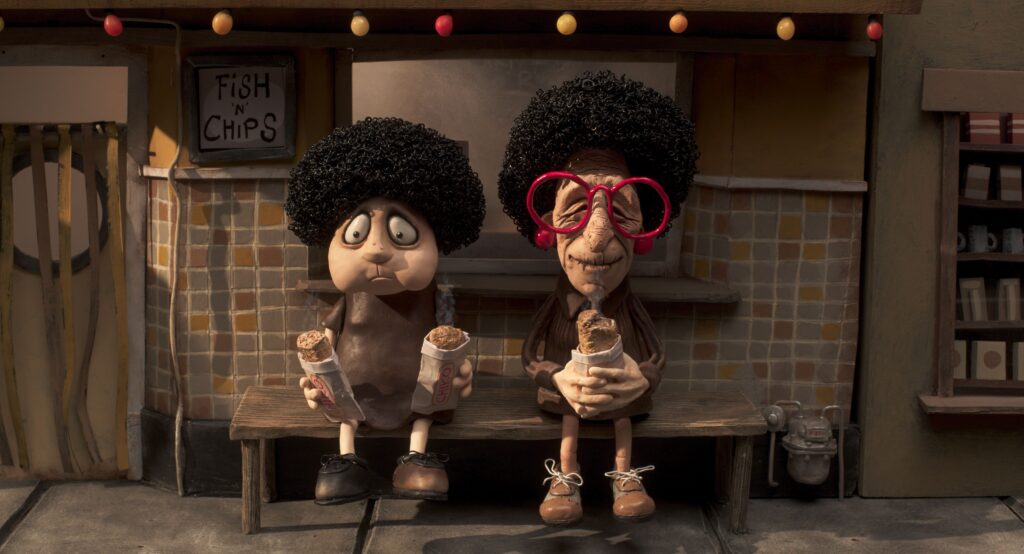
Pinky: The Unlikely Friend
Pinky is the friend everyone needs—the presence that arrives late in life yet understands Grace more fully than those who have known her longest. Despite her age, or perhaps because of it, she is the only person who truly perceives Grace. Where the world meets Grace with judgment or neglect, Pinky responds with irreverent warmth, humour, and a steadfast belief in silver linings. Grace’s fixation on snails mirrors her own desire to retreat from a world that repeatedly wounds her through an exploitative marriage, disordered eating, compulsive hoarding, isolating loneliness, and other bleak trials. Pinky, voiced with earthy precision by Jacki Weaver, offers not solutions but companionship. She validates Grace’s suffering without trying to fix it. Although Grace never fully escapes hardship, her bond with Pinky becomes a fragile anchor. Pinky’s own life has been marked by loss—two husbands, multiple abandoned jobs—yet she retains a defiant optimism. When Grace’s foster parents depart to join a nudist group, Pinky assumes the role of foster mother. She guides Grace through adolescence with affection, even as Grace remains depressed and adrift. Their roles eventually reverse when Pinky is diagnosed with Alzheimer’s, and Grace becomes her caretaker, returning the same irreverent warmth she once received. Pinky’s death scene, in which her last word is an inexplicable shout of ‘potatoes!’, is at once horrific and funny, an example of how the film lets humour bloom right at the edge of grief.
In the aftermath, Grace discovers Pinky’s parting gift—a box of savings under the potato plant accompanied by a letter urging her to live unburdened by the past. This act of care becomes the film’s emotional turning point, drawing Grace back from the brink and towards renewal. The lines from this letter cut through her grief with reassurance and enlightenment: »I’ve learnt that the worst cages are the ones we create for ourselves… Your cage has never been locked but your fears have kept you trapped. Get rid of those snails! Set yourself free… It’s time for you to shed your shell… A bit of self-pity is okay but it’s time to move on. There will be pain, but that’s life.«
In relinquishing her hoarded snail memorabilia, Grace is not erasing her pain but coming out of the cage she once built around herself, keeping only a handmade beanie for comfort. In doing so, her character undergoes a metamorphosis while honouring Pinky’s legacy—not by overcoming grief, but by learning to live alongside it. Grace continues to love snails, yet they no longer define or engulf her.
Endurance Over Hope
What ultimately carries Memoir of a Snail is Adam Elliot’s empathy rather than the precision of its plot mechanics. Despite moments of narrative contrivance and a conclusion that edges towards neatness, the film succeeds because it never trivialises or mocks Grace’s pain, even when it introduces dark comedy. Humour functions not as an escape from suffering but as a parallel register through which it becomes bearable. Visual ironies such as the bus carrying Gilbert away marked with the number plate »YRUSAD«, or the bureaucratic absurdity of a social worker’s identification photograph captured mid-cigarette—do not undercut grief but coexist with it, acknowledging the cruelty and absurdity that often accompany lived trauma.
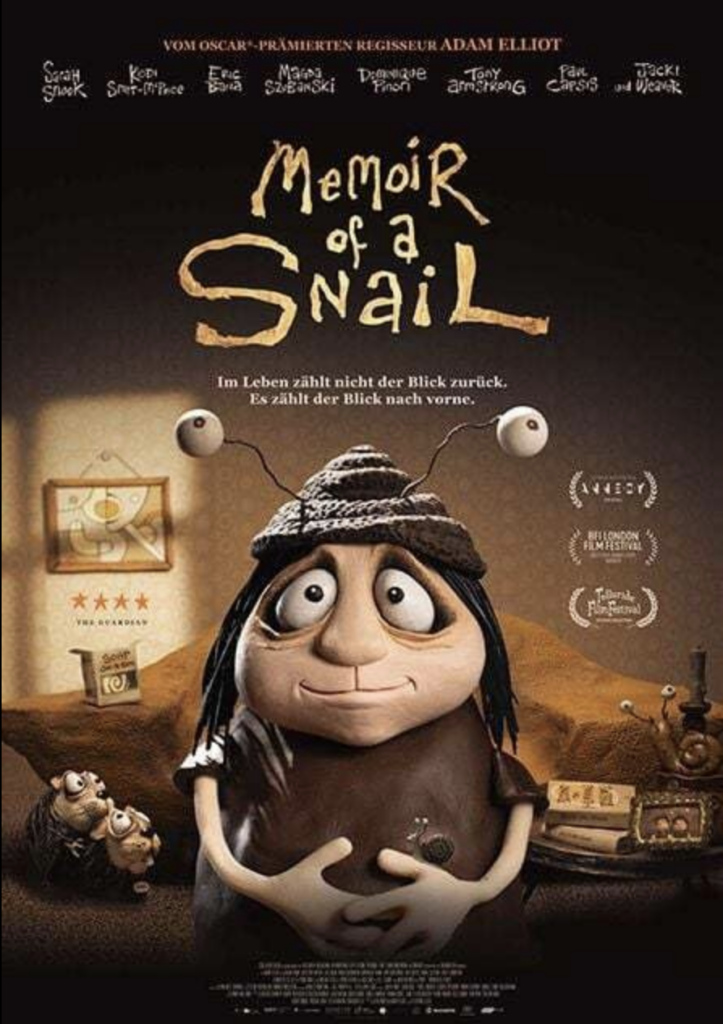
Memoir of a Snail (2024)
Director: Adam Elliot
Elliot’s sustained compassion for outsiders—those who stagnate, hoard, retreat, and fail—imbues the film with moral seriousness. He does not suggest that suffering is ennobling, nor does he frame pain as a necessary path to transcendence. Instead, the film proposes endurance itself as a profoundly human condition. Growth, when it occurs, is slow, uneven, and reluctant. This perspective resists inspirational platitudes and instead offers a quietly radical assertion: that survival, in all its messiness, is meaningful in its own right. Pinky remains central to maintaining this thematic balance. As the film’s primary source of levity, her unapologetic appetite for life injects warmth into an otherwise sombre narrative. Whether dancing atop bar tables or offering reassurance laced with irreverent humour, Pinky embodies a mode of living that does not deny suffering but refuses to be defined by it. Her friendship with Grace becomes the film’s emotional counterweight, demonstrating how connection, rather than resolution, sustains people through despair. Pinky’s final letter referencing Søren Kierkegaard’s assertion that life can only be understood backwards but must be lived forwards underscores this framing, suggesting that clarity often arrives too late, yet living must continue regardless.
Memoir of a Snail ultimately affirms Adam Elliot’s distinctive cinematic philosophy: that hardship need not be redeemed to be meaningful, and that survival itself can constitute a quiet form of grace. By refusing narrative consolation and easy transformation, the film honours the uneven rhythms of real emotional life. Its melancholia is never isolating; instead, it is tempered by tenderness, humour, and a sustained faith in human connection. Through Grace’s story, Elliot suggests that identity is shaped not only by loss and damage but by the fragile bonds we form in response to them. In its tactile visuals, compassionate characterisation, and commitment to emotional honesty, Memoir of a Snail becomes less a tale of overcoming adversity than a meditation on learning to inhabit it.