
Burhan Qurbani’s Kein Tier. So Wild. relocates Richard III to contemporary Berlin, transforming the infamous villain into Rashida, a woman fighting a male-dominated hierarchy. Blending social realism with surreal imagery, the film explores legitimacy, exclusion, and the cost of ambition.
By Shima Nasouti
The movie Kein Tier, So Wild. (2025) by Burhan Qurbani is not a rigid adaptation of Shakespeare’s Richard III. Instead, the movie takes the core of this classic tragedy and reshapes it within the criminal underworld of modern Berlin. At the center of the movie is Rashida, a fierce recreation of the traditional villain in Shakespeare’s play. Qurbani, who comes from an immigrant family, just like in his previous movie Berlin Alexanderplatz, draws on his own background and presents Berlin as a place where identity, ambition, and social exclusion collide.
Rashida: Villainy and Empathy
Turning Richard into Rashida is one of the boldest choices that the director has made. This is not just a superficial gender swap. Rashida, played by Kenda Hmeidan, radically changes the dynamics of ambition that we know and understand. Rashida’s hunger for power doesn’t come out of nowhere but it comes from the gendered structures which always kept her out. Shakespeare used Richard’s physical deformity in order to alienate him from society and also to justify his cruel actions. However, in Kein Tier, So Wild., the representation of Rashida’s ›deformity‹ is her gender and marginal status. Her existence is constantly underestimated, dismissed, and ignored in a brutal, male-dominated and criminal society. This exclusion is seen repeatedly in the way decisions are made without her, even when these decisions are directly related to her. Power negotiations happen in male-dominated spaces in which Rashida is mostly absent or just treated as a secondary presence. Even her own family always expects obedience and total loyalty and treats her ambition and desire for power as inappropriate.
Yet, Rashida’s character is made through this exclusion. Always being shut out and excluded makes her even hungrier for power. One of the differences between Rashida and her rivals in the criminal world is her background as a lawyer. Her education and understanding of the legal system give her a different kind of power. Then she gradually turns these skills against the very system she was educated to defend. This ultimately becomes Rashida’s secret weapon. Because her male rivals refuse to see her as a threat, she is able to observe, gather information and strike when it is least expected. Her rise is not built on acts of violence but on patience, planning and sudden action. In this way, the very system that always oppresses and denies her existence also enables her rise.
While Rashida’s brutal actions place her within the lineage of Shakespearean villains, the movie presents the psychological and social conditions driving her actions. By showing the long history of her being pushed aside and giving the audience access to her inner life, the movie encourages the viewer to empathize with her rather than condemning her actions. The film does not justify her ruthless actions and definitely doesn’t represent her as a righteous person. Instead, it presents her as a deeply conflicted individual shaped by both personal pain and ambition. This complexity is particularly visible after Rashida receives the news of her older brother’s death. Although she sheds tears, this is not only an expression of sadness. Her facial expression also reveals a sense of excitement and satisfaction at the removal of her main rival, as well as the deep hatred she had towards him. By showing these conflicting emotions at the same time, Qurbani allows the audience to gain a better understanding of Rashida. The film simply makes her human and multidimensional. Her violence feels like the tragic outcome of a world that left her with no other choice.
Berlin as a Stage of Realism and Surreal Imagery
Setting the story in Berlin is more than a simple modern update. The city’s sharp contrasts — wealth and poverty, diversity and exclusion — perfectly match the political tension in Shakespeare’s original play. Like Richard III, Rashida gains power by understanding how systems work and using them to her advantage. Richard manipulates political and legal structures in royal court to justify his claim to power, while Rashida uses her background as a lawyer to navigate and control the criminal world around her. Rashida’s battlegrounds are not the royal court but the housing blocks and dimly-lit clubs. The director presents these spaces in a realist mode, showing everyday streets, apartments, parking garages and clubs to form a recognizable world where power is traded through conversations, gestures and unspoken hierarchies.
However, Qurbani intentionally disrupts this realism and mixes it with surreal imagery. Much of the movie is grounded in realism. Yet, as Rashida climbs higher in terms of power, the scenes that seem to be stable like successful negotiations, moments of victory, or meetings to confirm loyalty turn into dream-like visions. Although the spaces remain physically the same, their atmosphere changes through distorted sound, ritualized movement or whispered choruses that surround Rashida.
While Shakespeare used soliloquies to show the audience Richard’s private thoughts, Qurbani replaces this verbal confession method with visual expression to reveal Rashida’s thoughts. The ghosts and prophecies from the original play are replaced by dream-like surreal moments that expose the deep anxiety and guilt she doesn’t want to reveal. These strange visions usually happen at the exact moments of her success and power, suggesting that the higher she climbs, the more her mental state collapses. By mixing realism and surrealism, the movie reminds the audience that becoming a villain is not just about power and success. It also results in a significant psychological cost.
Identity, Language, and Marginalization
The movie places the characters within an immigrant community dealing with generational conflicts and the search for belonging. Rashida’s family comes from Berlin’s Arab community, highlighting the clash between expectations of family loyalty and finding personal autonomy in a society filled with discrimination.
The way language is used in the movie adds more to this tension. The characters move easily between Arabic and German, showing the uneven and messy reality of integration for immigrants. While German dominates many public spaces and represents the language of social life, Arabic often appears in moments of intimacy, family, and emotional connection. This distinction is particularly visible in scenes involving Mishal, who acts as a mother figure for Rashida and plays an important role in her rise to power. Throughout the movie, Mishal mostly speaks in Arabic, while Rashida often responds in German. This contrast is especially clear in the scene at the funeral of Rashida’s two brothers, when Rashida and Mishal share an intimate moment, embracing each other while speaking in this pattern. Mishal’s use of Arabic highlights their emotional and cultural connection, while Rashida’s responses in German show her complicated position between her heritage and the world she wants to conquer. Through these language choices, Qurbani shows that identity and belonging are not fixed concepts but are constantly changing.
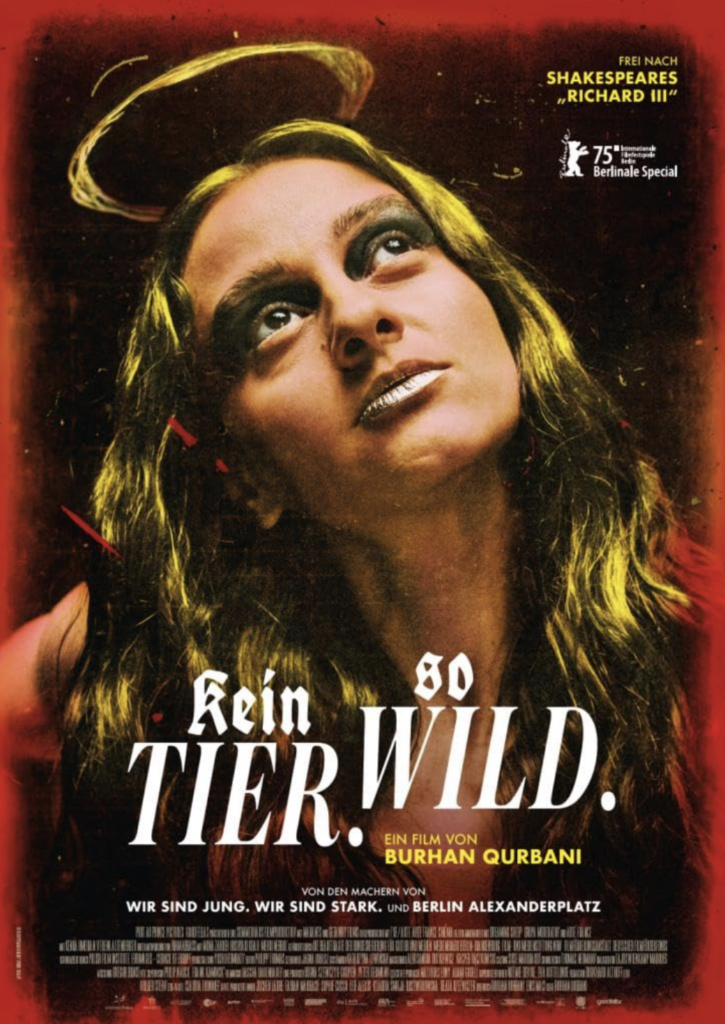
Kein Tier. So Wild.
Director: Burhan Qurbani
2025
This cultural background completely reshapes the original themes in Shakespeare’s play. Richard was an outcast because of his body but Rashida is an outcast because of her gender, race and social class. Her struggle is not just about ambition for power, but mostly about survival in a society that was never meant for her. By setting the story in Berlin’s immigrant community, the director turns Shakespeare’s question of who deserves power into a critique of marginalization in today’s world.
A Contemporary Reading of Power and Consequence
The movie, Kein Tier, So Wild., does not try to simply copy Shakespeare’s tragedy. Instead, it redefines its themes and gives them a new meaning in a different world. The classic story of a rise to power and the inevitable fall is still there, but the reasons behind it have changed. Shakespeare connected ambition to God’s will and royal bloodline, however Qurbani links it to modern realities like social pressure, insecurity, and the search for dignity. Kein Tier, So Wild. proves that Shakespeare’s focus on concepts like power, manipulation and moral corruption is still important, however their causes have changed. Set in a city full of diverse cultures and economic struggles, Rashida’s collapse does not feel like the downfall of a tyrant. Instead, it is the tragic breaking of a person whose identity was formed under different expectations and demands.
Kein Tier, So Wild. is not a conventional adaptation. It is uneven, incredibly bold and sometimes even contradictory. Yet, these contradictions are exactly what make it work. The movie mixes old Shakespearean themes with the multicultural reality of modern Berlin and, by placing a woman of color at the center of the story, successfully makes Richard III meaningful for a modern audience. If Shakespeare’s original play asked the audience what it takes to take over power, Qurbani’s version makes us face a more important question that is particularly relevant today: who is actually allowed to seek power and at what cost?