
Arbitrary arrests under the pretext of safeguarding public security. The governmental abuse of citizens’ private data for surveillance purposes. The economic exploitation and dehumanization of detainees. In her novel The Dream Hotel, Laila Lalami tells a story about a woman who experiences all of this.
Von Diana Muth
»The Border Czar«—as he was called by Donald Trump—Tom Homan, Director of the US Immigration and Customs Enforcement (ICE) recently stated: »You can detain and question people for a short period of time based on reasonable suspicion.« However, there are more and more reports of people being interrogated and deported from the US without any grounds for what might be called »reasonable suspicion«. One such case: 55-year-old Sae Joon Park, who had immigrated legally to the US at the age of 7, was deported to South Korea leaving behind his ill mother and family. Blunt racism seems to be »reasonable suspicion« enough, as also evidenced by the aggressive immigration crackdown in Minneapolis—in which three individuals were shot by ICE agents—and the targeting of the Somali community. A community which Trump called »garbage«.
Another case: 37-year-old Sara Hussein, of Moroccan descent, museum archivist and married mother of two young children, was arrested at Los Angeles International Airport for dreaming the wrong thing. Admittedly, this latter case is fictional and subject of the spine-chilling and kafkaesque »near-future dystopia« The Dream Hotel (2025) by the Moroccan American author Laila Lalami. She is an essayist, novelist as well as professor for Creative Writing in California and made a name for herself with her third novel The Moor’s Account, which was a finalist for the Pulitzer Prize in 2014.
Anything you dream can and will be used against you
In her latest and fifth novel The Dream Hotel, set in an unspecified period in the future, a new technology is being touted as revolutionizing sleep: a brain implant for a deep and refreshing night’s rest. As a mother of two infants, Sara initially enjoyed the beneficial effects of the neuroprosthetic but was unaware that her dreams are being decoded and sold to the government. Moreover, citizens are monitored and every data point is used, among other things, to algorithmically calculate risk scores. These scores are supposed to indicate how likely one is to commit a crime—a high score might have you detained preventively without even having thought about engaging in criminal activity. In the novel, the power of vast amounts of data leads to an orthodox belief in the algorithm, expressed by an attendant in the facility: »The algorithm knows what you’re thinking of doing, before even you know it. That’s a scientific fact. A forensic hold is for your own good, it prevents you from acting on your impulses.«
So, based on her dream data, Sara Hussein ends up in prison on the suspicion of soon committing vehicular manslaughter. What the real case of Sae Joon Park and the fictional one of Sara Hussein have in common: Both suffer the extreme consequences of a state using the pretext of crime prevention and security enhancement, thereby policing citizens and fuelling hatred toward migrants and marginalized groups for political gain.
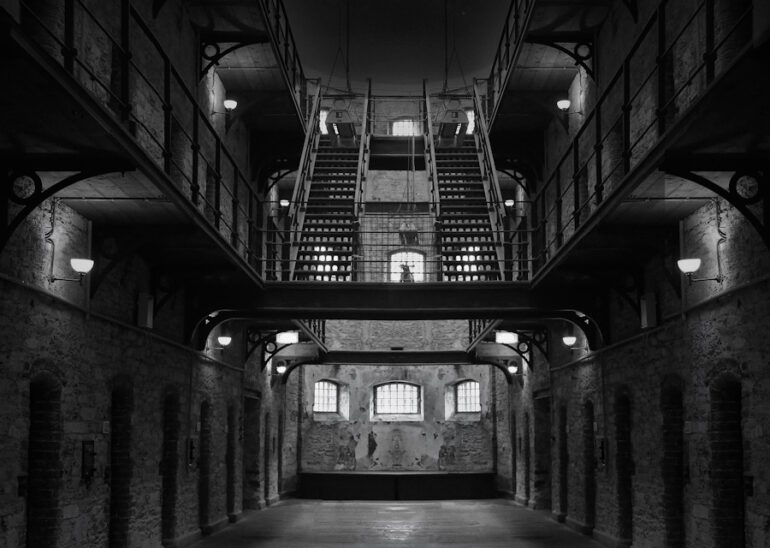
But while in Sae Joon Parks case, the primary reason for his deportation was racism, in Sara Hussein’s case, racism plays a secondary, though not insignificant role in her arrest. What is more significant is the question of why her initial 21 days of preventive detention turn into 343 days. More than eleven months in a facility where food is scarce and unhealthy, where family visits are a rare treat, where she is constantly monitored and exposed to the spiteful arbitrariness of the prison guards. The answer: economic profit. Sara realizes that the facility, a private institution commissioned by the state, profits financially from each inmate and therefore has no interest in letting people go.
Private prisons and the Economics of Incarceration
Here, the novel delves into the pressing non-fictional issue of the incentives and »economics of incarceration«. It presents a well-researched fictionalization of the situation that especially People of Color in the US face today: the imminent threat of racially motivated detention by ICE. The book’s depiction of many details surrounding detention, especially of for-profit private prisons, draws heavily on actual reporting and thus ties into current public debates: Annually, the U.S. government spends more than $3.9 billion on private prisons, whose operators, in turn, reap billions by imposing premiums of up to 600% on food, healthcare, and telecommunications for inmates. A staggering 85% of individuals in immigration custody are confined within profit-driven, privately managed detention facilities, as the Financial Times reported recently. One of those detainees, Maurilio Ambricio, pastor and handyman, was »arrested at one of his regular immigration check-ins after two decades in the US« and »describes overcrowding, inadequate food and abuse from staff, with some referring to detainees as ›pigs‹. ›All detention centres treat us like animals‹, he says.«
The other side of the coin
Nevertheless, it must be noted that the novel appears to take part in a discursive shift in liberal debates about immigration: The issues of how to integrate undocumented immigrants and their pathways to citizenship have fallen off the agenda. The once-firm rhetoric among liberals that every human being, regardless of their legal status and origin, is entitled to a peaceful and poverty-free life erodes publicly. But since even legal immigrants and citizens now must face arbitrary arrests, many people with legal status and no criminal record feel pressured to assert their identities as good, law-abiding and valuable citizens. While these are inevitable assertions in the face of potentially fatal ICE-aggressions, the many lives and pressures of undocumented immigrants appear to slip out of sight.
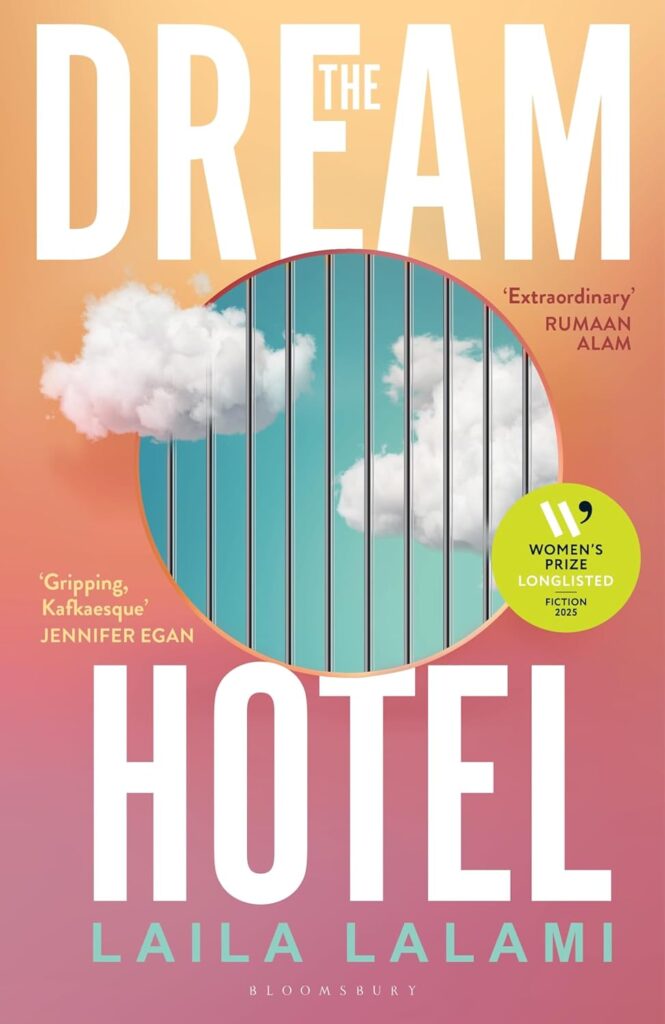
The Dream Hotel
Bloomsbury Circus: 2025
336 Pages, 14 €
A worthwhile piece of engaged literature
Aside from that, certain storytelling aspects of the novel can be criticized. This includes a lack of narrative density due to unresolved plotlines, the book’s tendency toward a more essayistic tone than one typically anticipates in a literary work, along with an abruptly optimistic ending that seems somewhat forced and unrealistic—possibly to sidestep any sense of defeatist alarmism.
Still, the merit of The Dream Hotel lies in its meticulous examination of the grievances surrounding detention, weaving them into a narrative that gives form to abstract facts and data, creating parallels to the reader’s own life. The private prison system, its conditions and impact upon the incarcerated are depicted psychologically astutely, highlighting the degradation and dehumanization it fosters. The novel cautions us about the future we risk when the Frankenstein-like entity we have both created and normalized—the big datafication of our everyday lives—merges with increasingly authoritarian surveillance capitalism. A near-future dystopia indeed, it may seem.