
From rural Ireland to the digital world of Instagram, women are still being told who they should be. This article pairs Irish author Louise O’Neill’s novel Asking for It with American singer Sofia Isella’s track Doll People, and delves into how objectification and dehumanization are confronted through artistic expression. Despite their differences in medium and context, both works highlight a shared struggle.
By Ravgun Kaur
While some classroom lightbulb moments are born at a desk, mine happened while I was scrolling on my phone in bed, hours after class had ended. I came across a song on Instagram that echoed the very ideas we had discussed earlier that day. The fact that I was still engaged by the Irish Women’s Literature seminar, even during an activity that tends to sap my attention span like scrolling through reels, where it’s easy to lose focus with every swipe, says a lot about it. The recommended reading list for this course showcased Irish women’s voices across decades and themes: Anne Enright’s The Gathering explored the claustrophobic tangle of Irish family life; Claire Keegan’s Small Things Like These confronted the quiet horrors of the Magdalene laundries; and, Louise O’Neill’s Asking for It — a raw and unsettling novel about rape culture and identity — brought the discussion into the urgent present. Although the course focused on the experiences of Irish women, I left realizing that the issues it raised were universal.
From Personhood to Pixels
Asking for It by Louise O’Neill is the novel that has had the greatest impact on me. It tells the story of Emma O’Donovan, a teenager whose photographs are leaked online without her consent. What follows is not just an assault on her privacy, but on her very sense of self. Social media becomes a courtroom in which strangers decide whether she is a victim or a liar, a slut or a cautionary tale. Either way, Emma is stripped of the ability to define herself. The novel is a case study in how women’s identities are so often constructed — or dismantled — by forces beyond their control.
One of the main topics discussed in class was about Emma’s loss of identity through digital objectification. We read Helen Penet’s Fiction in the Age of Digital Photography, which draws a striking parallel between pixelation and the fragmentation of women’s bodies. As Penet suggests that zooming into an image until it dissolves into pixels mirrors the way women’s bodies are broken into parts for scrutiny — legs, lips and breasts — until the whole person disappears. In Emma’s case, this is not a metaphor but a reality: her leaked photos are passed around online, dissected, commented on and consumed. She stops being Emma, a girl with ambitions and fears, and becomes »pink flesh« with »splayed legs«. This is the brutal logic of objectification in the digital age: a living person becomes a consumable image, pixelated into pieces.
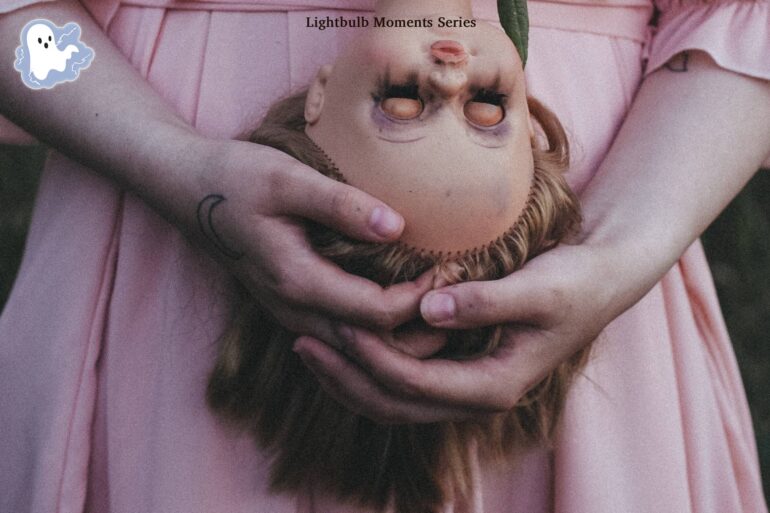
When the class finished at around 6 pm, I left the room — and the conversation — behind. Less than two hours later, like any good 21st-century student, I was in the middle of my usual Instagram scrolling session when I heard it again. The haunting lyrics of Sofia Isella’s trending song, Doll People, struck me as déjà vu: »Our skin is clay and painted blue. Our head can detach. We are statues with a pulse.« These lines felt like a continuation of Emma’s own thoughts in Asking for It: »She has no face… a life-size doll to play with. She is an ›it‹. She is a thing. (me, me, me, me)«. This unfortunate parallel between two women — an Irish novelist and an American musician—became my lightbulb moment. Despite being from different continents and having no familiarity with each other, the two women articulate the same experience: the transformation of a living woman into a lifeless doll, a statue, an object.
In Asking for It, Emma’s identity is systematically dismantled, both through external judgment and the internalization of it. Her sense of self begins to fracture when she first sees her leaked photos, reducing her body to nothing but »splayed legs« in her mind. This stark imagery is echoed in Sofia Isella’s Doll People, where a similarly dehumanizing phrase, »legs spread like butter«, captures the way women’s bodies are reduced to objects for consumption.
From Pixels to Projection
As Emma’s story progresses, these words cease to describe a moment and begin to define her entire identity. She no longer sees herself as a person, but as a lifeless, fragmented doll. A body shaped by other people’s gazes. Social media only deepens this sense of dislocation, providing reactions that may be sympathetic or cruel, but which never give her control over her own narrative. O’Neill renders this psychological rupture visible in therapy, where Emma draws her body at one end of the page and herself — not merely a dot — at the other, as if the distance between them has become unbridgeable.
Isella captures this same sense of dissociation and voicelessness in her lyrics: »The doll people are quiet, what is there to say? Art does not interpret itself, there are men with a day to save.« Here, the »doll people« — like Emma — are stripped of agency and speech, trapped in others’ interpretations. »The men with a day to save« represent the larger patriarchal, institutional and cultural forces that claim the authority to define women.
Through both the novel and the song, we see how objectification can lead to a deep psychic split, a loss of voice, self, and agency. Yet, within that fragmentation, both works also hint at the slow, painful process of resisting and reclaiming identity.
This loss of self ultimately culminates in Emma’s devastating decision to withdraw her complaint against her rapists. The novel ends with her saying, »It’s important that I look like a good girl.« At that moment, O’Neill reveals the power of the internalized male gaze: Emma has learned that being seen as good, respectable, and unthreatening matters more than telling the truth or seeking justice. Her silence becomes a kind of survival, shaped by the voices around her. External perception also sets the terms of value in Isella’s lyrics too: »To be admired takes precedence over admiring. To be desired takes precedence over desiring.« In both works, women are conditioned to mold themselves to the gaze of others, even at the expense of their own agency. Emma’s feelings and desires are buried beneath the pressure to conform to the male gaze.
Lightbulb Moments: Insights from the Classroom
What topics captivated you during your studies and never let you go? Was there a seminar you once took or an exam you completed that led to an important new realization? Our series »Lightbulb Moments: Insights from the Classroom« is dedicated to making exactly these moments visible. Here, authors reflect on their personal »Lightbulb Moments« — those pivotal moments during courses or lectures that left a lasting impact.
The texts are published at irregular intervals and can be found here.
The pressure to be seen »the right way« not only shapes how women behave, but it also influences the language used to define them. The parallels between Asking for It and Doll People become clearer when we consider how each artist addresses this labelling. Isella’s haunting hook »Wife. Whore. Mistress. Maid. Mother.« collapses socially sanctioned roles and sexist slurs into a single breath. This strips away the illusion that »respectable« roles offer any real protection from judgment. O’Neill mirrors this flattening through Emma’s internal monologue: »Slut. Liar. Skank. Bitch. Whore.« Whether intended as praise or condemnation, these labels still reduce women to objects of perception, meant to be judged, consumed and discarded.
From Pixels to Power
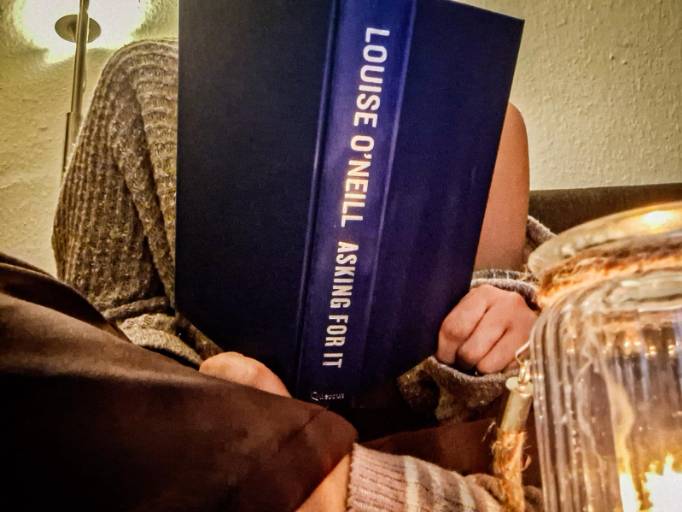
But the power of these works lies not just in exposing this phenomenon, but in how they subvert it. Doll People, sung in a haunted, satirical tone, names its own subject — women reduced to passive, silent figures — and reclaims that label by turning it into sharp critique. The title becomes a form of resistance: by naming the system, Isella refuses to be defined by it. O’Neill’s Asking for It functions similarly. A phrase often weaponized to shame survivors becomes, in her hands, an ironic and devastating indictment of a culture that normalizes victim blaming. In both cases, the titles themselves serve as acts of resistance, enabling these female artists to do more than merely represent objectification: they can also redefine and defy it.
This strong reclamation of voice and identity knows no geographical or medium-specific boundaries. This class shows me that these issues, deeply rooted in Ireland’s history from the Magdalene Laundries to modern-day rape culture, resonate across continents, art forms, and generations. Through literature, music, and even the unexpected intimacy of social media, women around the world are expressing the same desire: to reclaim their identities, reject dehumanization and become whole again.
That evening, when I came across Isella’s Doll People played on an Instagram reel, I felt the global chorus come alive in a new way. I realized that the classroom had broadened my perspective — it had changed the way I saw and even how I listened to the world. I could now hear the echoes between these voices: Emma’s in O’Neill’s novel, Isella’s in her lyrics, and countless others pushing back against the labels and roles imposed on them. Although Asking for It ends without resolution, it leaves behind a sharp ache, a hunger for justice that lingers long after the final page has been turned. Emma remains a victim, and the title remains unchanged. But that’s precisely O’Neill’s point: by refusing to rewrite reality as something neater or more redemptive, she reclaims the phrase, »She was ›asking for it‹« and exposes the cruelty of its use.
Isella, on the other hand, offers a glimpse of something beyond mere survival. While the external label of »dolls« is not erased as Doll People ends, it is reimagined and reclaimedwith the dolls »running, laughing, swimming in the milk of the moon«. These »doll people« are no longer silent or broken, they are in motion, experiencing joy and living in community. In that final haunting yet hopeful image, we see what reclamation can look like: not just resistance, but renewal.