


Yvonne Vera’s novel Butterfly Burning tells the story of Phephelaphi, a young woman and her fight (and flight) for freedom. Her story is often eclipsed by flames, this lightbulb moment article, however, focuses on the presence of water in the text.
Content note: The following text includes descriptions of abortion.
By Thandizo Kawerama
Picture: Via Pixabay, CC0 (edited)
The phrase ›water has memory‹ comes from a concept popularised by immunologist Dr. Jaques Benveniste. He theorised that there are »molecular-like effects without molecules«1Beauvais, F. Benveniste’s Experiments and the So-Called “Water Memory” Phenomenon: an Example of Serendipity?. Preprints 2023, 2023010155. https://doi.org/10.20944/preprints202301.0155.v1present in water. When elaborated, this statement speaks to water retaining properties of substances long after the substances have been dissolved. This hypothesis is based on the understanding that the transient characteristic of hydrogen bonds in water breaking and reforming at a rapid pace allows for molecules to adapt to various stimuli. Thus, allowing water to retain information through the formation of these molecular clusters.2More about this on Teleologico. Benveniste’s theory has been widely contested, his own obituary focusing more on his hypothesis than who he was outside of the controversy. This article does not seek to examine Benveniste’s theory, but rather serves as introspection on a literary interpretation of his hypothesis. A perspective where water is personified as an omnipresent entity; a record keeper of the past, present and the future.
I first came across the phrase ›water has memory‹ while watching Frozen 2. In the movie, water has the ability to display vivid images of past events. It is through confronting the past that was hidden in the waters that the characters in the movie are able to move forward and resolve the plot. While the phrase had a very literal meaning in the movie, the metaphorical component of water holding memory followed me long after the credits rolled. Inspired by the symbolism in the plot, I sought to better understand the phrase that had left such a strong impression on me. My curiosity led me to the discourse surrounding Benveniste’s theory, and further brought me back to a novel that I had revisited time and time again throughout my 20s, Yvonne Vera’s Butterfly Burning.
Butterfly Burning was assigned reading for my university’s BA programme. I did not think too much of the novel outside of needing to analyse it to pass my African Literature course. Little did I know it would be a text that would have a lasting effect on my academic career. Years after my initial reading, I am currently pursuing my Masters in English Language Literatures and Cultures, thousands of kilometres away from the place I first encountered the text. To me, Butterfly Burning has always been a mirror reflecting the harsh realities of a society shackled to its obsession with power. During my most recent reading, influenced by the phrase ›water has memory‹; and further my consideration of the novel as a primary text for my master’s thesis, my focus was not on any character in particular. Rather I fixated on the River Umguza, the body of water that stands as a silent witness to the tragedies that occurred in Makokoba, Zimbabwe.
Journey to the River
We begin the journey with our protagonist, Phephelaphi, a young girl in her early 20s springing up from the River Umguza into the hands of Fumbatha3Fumbatha means to make a tight fist/firmly grip.. Fumbatha, a man who faced the River decades prior to their fated meeting, clings to the promise of Phephelaphi. As a young boy, he crossed the River to be confronted with the reality of his existence being eclipsed by the shadow of his father’s lynched body, and has since spent most of his life barely making a living as a construction worker in Makokoba, a township which falls under the jurisdiction of the colonial government in present-day Zimbabwe. Now in his 50s, finding himself trapped in an endless cycle of poverty and despair, he sees Phephelaphi as his second chance at life. In Fumbatha’s eyes, Phephelaphi is a gift from the River Umguza itself, a jewel he grips firmly – and hence she becomes, not a person, but a symbol (or object) of the life he aspires to lead through her: »Fumbatha retrieves a bracelet and wears it on his right wrist…broken memory and a buried touch. He encloses it, encircles it by placing his left thumb and forefingers over it. Touching time like something solid which can be born several times before it dies. A healing fragment, a wish.«
Soon after their first meeting, the couple start a new life together. Phephelaphi moves into Fumbatha’s home and he takes on the role of her provider. The premise of their relationship is charged with passion. Fumbatha desires that Phephelaphi has no life outside of domesticity, and Phephelaphi is simply grateful to be cherished by someone after the recent murder of her mother. Thus, she becomes a kept woman as best as he can provide for. Their nosy neighbours refer to her as a »woman without blemish«, and she becomes a woman who lives only to wait for her lover’s return after his days away at work. However, their fantasy is short lived as Phephelaphi grows tired of her golden cage. She begins to seek her own identity, much to his disapproval. At the height of her fight for independence, she falls pregnant. Devastated by the prospect of a reality where she must regress back to Fumbatha’s desires for her life, she performs an abortion on herself. The abortion is the start of a sequence of events that lead to her eventual demise, whereby she ends her life by setting herself on fire in front of Fumbatha and the residents of Makokoba.
Water as a Place of Remembrance
Benveniste’s hypothesis, the Umguza River is the water which holds the memories of the events that occur in Makokoba, is present at the birth of Fumbatha and Phephelaphi’s ill-fated relationship, and it is also the lonely presence that loomed during the lynching of Fumbatha’s father. Holding the history of its people and being the presence that will remain long after the residents passing.
Phephelaphi, desperate for a new beginning, enters the River and emerges on the other side anew. Blind to the events that are to come, the knowing waters prepare her body for the ordeal she is to endure: »Phephelaphi was unaware of the manner in which she had, by presence, transformed him. they were strangers. They had already met. She had swum toward him from the opposite shore, hidden under the water.« Upon their meeting, Phephelapi and Fumbatha are described as both strangers and acquaintances. This speaks to the historical aspect of the River. It is a shared space in which all the residents of the township are familiar. Time before and after their meeting merge into one as Phephelaphi breaches the River’s waters. In the waters of the Umguza, Phephelaphi is reborn. She becomes dead to her past, and is found anew as Fumbatha’s shelter4Phephelaphi means shelter., a memento he wears on his wrist to protect himself from the realities of his disenfranchised position in society.
Lightbulb Moments: Insights from the Classroom
What topics captivated you during your studies and never let you go? Was there a seminar you once took or an exam you completed that led to an important new realization? Our series »Lightbulb Moments: Insights from the Classroom« is dedicated to making exactly these moments visible. Here, authors reflect on their personal »Lightbulb Moments« — those pivotal moments during courses or lectures that left a lasting impact.
The texts are published at irregular intervals and can be found here.
Phephelaphi, like many of the other female characters in the text in relation to their male counterparts, finds herself becoming a balm to his wounds. However, though Fumbatha is a victim, she was never meant for him to possess as consolation to his anguish. But a man bearing a name that translates to »a tight fist« does not understand what it means to set another free. Fumbatha has placed his worth in the stability of the soil, and Phephelaphi is of the river. They are incompatible. Fumbatha is aware that Phephelaphi does not belong to him. He understands that there is a world between them, yet he still attempts to possess her. When he fails, he casts his own shame onto her and renames it greed. »This river grows among thorns. This river does not belong to dry land. It is greedy and gives nothing of its water.« Fumbatha, defeated by his circumstance, has become barren land.
The Dual Nature of Water
Through record keeping, the River serves as a representation of the life-death axis; the spectrum on which life and death are examined not as separate entities, but as compliments where each phenomena provides insight into the other. Consequently, the Umguza River becomes the place where life is given and life is lost, holding remnants and relics of the stories of the residents of the township: »Where it can, the river digs ancient histories out of the ground. A piece of broken clay. A necklace made of glass. Bracelets with markings telling of birth, marriage, death. A hidden message. An invitation, tempting and undisclosed.« In this manner, the River has always been with, and been part of its people.
Thus, the Umguza River holds the characters hopes, and dreams. The hope of a lover who lulls you into forgetting the harsh realities of life, the memory of a father who fought bravely against colonial powers. However, it often reflects back to them that which they do not wish to see. The reality of a love that is too good to be true, and the halo of a father who was silenced. Even after the characters have moved on from the events that led to Phephelaphi’s demise, the River remains as a record to all that was and all that will be.
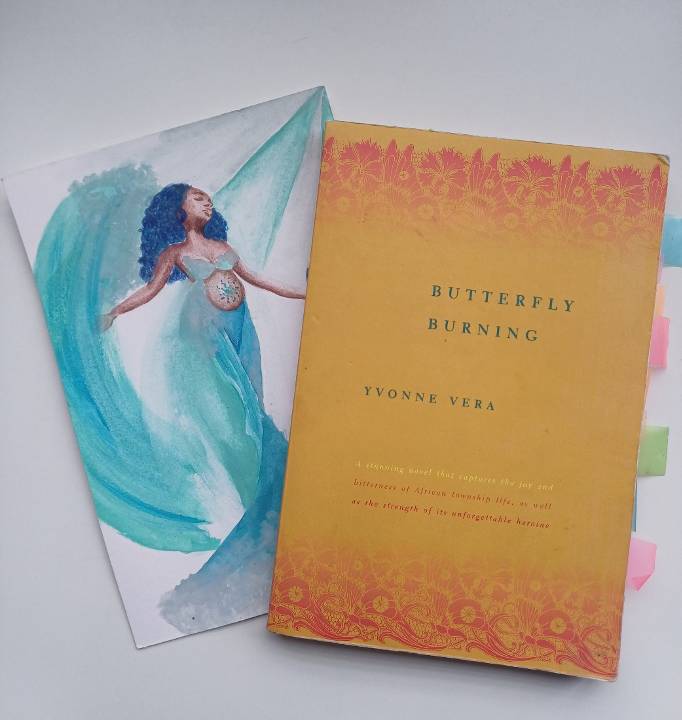
Butterfly Burning does not have a happy ending. Although Phephelaphi’s choice to end her life can be read as a final act of freedom, it can also be said that there is no joy in the premature ending of a life. It is with this understanding in mind that in my most recent reading of the text, I consider the River a silent companion during her darkest moments. That when Phephelaphi reached the point of no return, the River made a vow to remember her story. Therefore, while Benveniste may have been met with much disagreement on his theory, a different interpretation of his message made itself known through Yvonne Vera, the author of Butterfly Burning. There is a comfort in the phrase ›water has memory‹ as it reminds us that you are never truly alone. There has, and always will be a past, present and future we are all a part of. Considering this interconnection, it is no wonder then that when the Lightbulb Moments Series was announced, I looked back on the passage of time and immediately returned to Phephelaphi’s warm embrace.